Texas Longhorns vs. Ohio State – The Texas Miracle

Full Text / Article Transcript 
Twenty Points from Dead: How Texas Broke No. 1 Ohio State and Changed the Meaning of Its Season
Albert N. Clark
Independent Author
Published: September 14, 2026
ASX Research Journal and Database
ISSN 3068-3351 (Online)
Place of Publication: Cadiz City, Philippines
Publisher: ASXResearch.org
Author Note
Albert N. Clark
Department of Aerospace Sciences, ASXResearch.org
ORCID iD: https://orcid.org/0009-0002-7348-4395
The author reports no conflicts of interest.
Correspondence concerning this article should be addressed to Albert N. Clark, Email: [email protected]
Abstract
Texas’ 24–23 comeback victory over No. 1 Ohio State on September 12, 2026, transformed an early-season heavyweight matchup into one of the defining college football games of the year. After trailing 23–3 entering the fourth quarter, the Longhorns scored 21 unanswered points behind Arch Manning, Hollywood Smothers, a resilient Texas defense, and a series of high-risk fourth-down decisions by head coach Steve Sarkisian. This article examines the historical, tactical, psychological, and cultural forces that produced the upset, including Texas’ recent failures against Ohio State, Manning’s development under extraordinary expectations, roster changes, defensive adjustments, home-field effects, crowd influence, and Ohio State’s inability to close the game. It also explores the broader significance of the victory for Texas’ 2026 season, arguing that the comeback may represent a shift in the program’s competitive identity from talented contender to psychologically hardened championship threat. While the win does not eliminate concerns involving offensive consistency, rushing efficiency, execution, or decision-making, it provides Texas with something equally valuable: evidence that the team can recover from near-certain defeat against the nation’s top-ranked opponent. The coming SEC schedule will determine whether the game becomes an extraordinary isolated moment or the defining origin story of a championship season.
Keywords: Texas Longhorns; Arch Manning; college football upset
Twenty Points from Dead: How Texas Broke No. 1 Ohio State and Changed the Meaning of Its Season
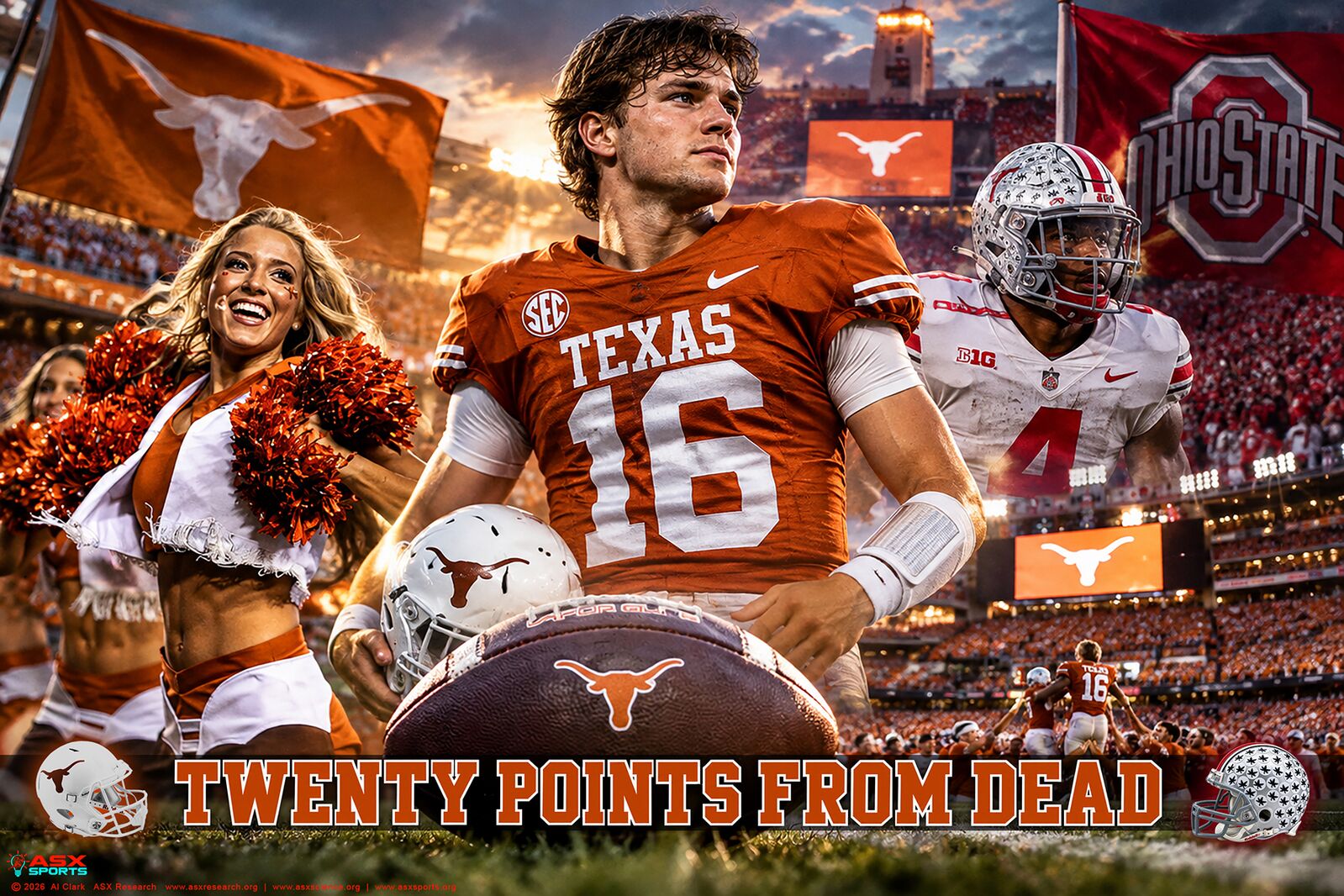
On September 12, 2026, Texas did something that should be understood as more than a Week 2 upset. The No. 4 Longhorns entered the fourth quarter at Darrell K Royal–Texas Memorial Stadium trailing No. 1 Ohio State 23–3, then scored touchdowns on three consecutive possessions and won 24–23 when Hollywood Smothers vaulted across the goal line from one yard with 25 seconds remaining. Texas became the first team since at least 2004 to erase a 20-point fourth-quarter deficit against an Associated Press No. 1 team; AP reported it as the largest fourth-quarter comeback ever completed against an AP No. 1. Before Saturday, top-ranked teams had been 197–0 since 2004 when carrying a 20-point advantage into the fourth quarter. Texas also defeated an AP No. 1 opponent for the first time since beating SMU in 1950. This was not a routine upset produced by one broken coverage, one freak turnover, or one desperate Hail Mary. Texas drove 91, 72, and 73 yards for its three fourth-quarter touchdowns. It took 40 offensive plays to manufacture those scores. It had to keep solving Ohio State again and again, with almost no margin for another mistake. That distinction matters: Texas did not steal this game in one chaotic instant; over the final quarter, it systematically took it away.
The emotional roots of the comeback extend much deeper than this season. Ohio State had become the recurring antagonist in Texas’ return to national relevance. In the January 2025 College Football Playoff semifinal, the Longhorns were tied 14–14 with the Buckeyes entering the fourth quarter and later reached the Ohio State one-yard line with an opportunity to tie the game. Texas was pushed backward, and on fourth down Jack Sawyer stripped former Ohio State roommate Quinn Ewers and returned the fumble 83 yards for the touchdown that effectively ended Texas’ season, 28–14. Eight months later, Arch Manning made his first full season-opening start as Texas’ quarterback at Ohio Stadium with Texas ranked No. 1. Ohio State beat Texas again, 14–7. Manning threw for only 170 yards with a touchdown and interception, and the mythology surrounding his surname immediately turned from hype into interrogation. By Saturday night in Austin, therefore, Texas was not merely trying to defeat Ohio State. The program was confronting a team that had twice become the physical embodiment of where its national ambitions stopped. The third consecutive meeting offered something unusually rare in modern college football: a chance for revenge before the scar tissue had even healed.
Texas’ 2025 season made that wound more complicated. The Longhorns began the year as the preseason No. 1 team but finished 10–3 and missed the College Football Playoff, losing not only at Ohio State but 29–21 at Florida and 35–10 at Georgia. Manning’s first year as the full-time starter was consequently subjected to a bizarre public standard: a young quarterback could throw for 3,163 yards, account for 36 total touchdowns, become noticeably better as the season progressed, and still be portrayed as disappointing because the name on the back of his jersey was Manning. His closing stretch told a different story. He accounted for 15 touchdowns against one interception over Texas’ final five games, beat Texas A&M, then dismantled Michigan in the Citrus Bowl with 221 passing yards, 155 rushing yards, two passing touchdowns and two rushing touchdowns. Texas finished 10–3, but Manning finished 2025 looking considerably more dangerous than the player who had begun it in Columbus. That matters to Saturday because the quarterback who was buried under a 20-point deficit was not the same quarterback Ohio State had frustrated a year earlier. The failure was part of the construction process.
Steve Sarkisian spent the offseason acknowledging that reality without treating 10 wins as good enough. Texas added Auburn receiver Cam Coleman, USC running back Raleek Brown, North Carolina State running back Hollywood Smothers and offensive-line help, while Sarkisian made his most consequential defensive-staff change in years by bringing Will Muschamp back to Austin as defensive coordinator. Muschamp had previously coordinated Texas defenses from 2008 through 2010 and returned with former Texas safety Blake Gideon assisting the secondary. The result was a roster constructed less like a developmental project and more like a championship wager on Manning’s likely final college season. Texas opened 2026 by vaporizing Texas State 59–7 before 102,738 spectators. Manning went 20-for-27 for 305 yards and four touchdowns, Ryan Wingo produced 121 receiving yards, Smothers rushed for 70, and the Longhorns converted 11 of 15 third downs. The warning hidden inside that demolition was the running game: Texas State still produced numerous stuffs at the line of scrimmage. Ohio State was obviously capable of exploiting weaknesses that Texas State could merely reveal.
Ohio State arrived in Austin with every reason to believe it remained the superior machine. The Buckeyes had gone 12–2 in 2025, defeated Michigan in Ann Arbor, reached the Big Ten Championship Game, and entered the College Football Playoff before losing to Miami in the Cotton Bowl quarterfinal. Quarterback Julian Sayin returned after throwing for 3,610 yards and 32 touchdowns in 2025 with a national-best 77 percent completion rate, while Jeremiah Smith entered what was expected to be his final college season already regarded as arguably the most gifted receiver in the sport. Ohio State began 2026 ranked No. 1 and annihilated Ball State 56–3; Sayin threw for 320 yards and three touchdowns. Thus this was not a paper No. 1 caught before it had awakened. Ohio State came to Austin with an established quarterback, an extraordinary receiver, recent championship pedigree, and two consecutive victories over Texas. Texas was favored by only about a point and a half in many markets. The upset was not that Texas could theoretically beat Ohio State; a top-four team at home certainly could. The staggering part was the path Texas took to doing it.
For three quarters, the path looked like another funeral. Ohio State led 10–0 after the first quarter and 20–3 at halftime. Texas’ only first-half points came after a 16-play, 69-yard drive that ended with Gianni Spetic’s 37-yard field goal. Manning was 7-for-14 for 60 yards in the opening half, and even some of his statistically charged mistakes were not entirely his own. Cam Coleman failed to secure a deep ball that became an interception, while Wingo dropped what should have been a touchdown. Ohio State, meanwhile, was brutally efficient through the air. Sayin completed 75 percent of his first-half attempts for 192 yards, and Smith finished the game with eight catches for 164 yards and a touchdown. A 48-yard Connor Hawkins field goal with 8:09 remaining in the third quarter made it 23–3. At that moment, the game looked less like redemption than repetition: Texas was again discovering that Ohio State could turn its greatest expectations into psychological baggage. ESPN’s win-probability model reportedly placed Texas at roughly 1.9 percent.
What prevented 23–3 from becoming 33–3 was Muschamp’s defense, and this may be the most important part of the game for understanding Texas’ championship potential. Ohio State finished with 372 total yards but only 94 rushing yards on 31 attempts. Its longest run was 11 yards. The Buckeyes reached the Texas 13 on fourth-and-two during the second quarter and failed. After going ahead 23–3, Ohio State could not manufacture the kind of sustained rushing possessions that kill a comeback before it develops. Sayin completed only six of 16 passes after halftime, and Texas ultimately outgained Ohio State 239–132 in the second half. Bo Mascoe and the Texas secondary did not erase Smith—nobody did—but the defense increasingly disrupted Ohio State’s timing and forced Sayin to keep solving the game rather than allowing the Buckeyes to sit on it. That distinction is where criticism of Ohio State’s conservative second-half approach meets credit Texas deserves: a team cannot successfully “protect” a lead if the opponent refuses to allow it to run the football.
The play that changed the evening did not score a point. Facing fourth-and-nine from the Texas 42 late in the third quarter, Sarkisian could have punted, accepted that the game was probably lost and prevented the score from getting uglier. Instead Manning rolled, threw across his body and found tight end Emaree Winston for exactly the yardage Texas needed. The drive remained alive. Shortly after the fourth quarter began, Manning connected with Wingo for a three-yard touchdown, completing a 15-play, 91-yard march that consumed 6:28 and made it 23–10. Sarkisian later rejected the premise that he should have punted merely to keep the defeat respectable: his job, as he framed it, was to try to win. That fourth-and-nine deserves to survive in Texas history alongside the touchdowns because it represented the precise instant at which Texas refused the expected ending. The scoreboard still said Ohio State was in control. Texas’ behavior suddenly said otherwise.
Then the atmosphere changed from hope to threat. Ohio State went three-and-out after the first Texas touchdown, and the Longhorns started again from their own 28. Manning converted another astonishing fourth down, this time fourth-and-six from his own 32, finding Emmett Mosley V to keep the possession alive. Texas drove 72 yards in 13 plays, and Smothers punched in the first of his two one-yard touchdowns with 7:14 remaining. Suddenly it was 23–17, and Ohio State was no longer playing against a three-score deficit; it was attempting to survive a one-possession game inside a stadium containing 105,044 increasingly convinced people. Psychological momentum should not be treated as magic—sport-science literature is more careful than television announcers—but Den Hartigh et al. (2016) demonstrated that positive momentum can interact with self-efficacy and effort across multiple time scales, while Briki (2017) described momentum as a psycho-behavioral process in which perception, physiology, behavior, and performance can become mutually reinforcing. Texas was demonstrating almost the laboratory illustration: a fourth-down conversion created a touchdown, the touchdown energized the defense and crowd, the stop created another possession, and the next conversion made belief increasingly rational rather than merely emotional.
Ohio State still had one clean opportunity to close the door. The Buckeyes moved into field-goal range with a little more than four minutes remaining, but Hawkins pulled a 45-yard attempt left after having already made kicks from 26, 30, and 48 yards. Texas took possession and went 73 yards in 12 plays. Manning distributed the ball rather than hunting for a single heroic throw, the Longhorn offensive line survived the pressure, and Smothers finished the drive by launching himself over the pile from the one. The touchdown tied the game at 23 with 25 seconds remaining; Spetic’s extra point produced Texas’ first lead of the entire evening. Ohio State had one final desperate possession, but Graceson Littleton intercepted Sayin to end it. Texas had gone from 23–3 down to 24–23 ahead without Ohio State scoring a single fourth-quarter point. The three scoring drives covered 236 yards. That is the number that destroys the idea that Texas merely got lucky. Luck can help produce a missed field goal. Luck does not usually produce 236 yards of consecutive pressure football against the No. 1 team in the country.
Arch Manning’s personal story may be the central story because his greatest accomplishment Saturday was not statistical. His official line—23 completions on 37 attempts, roughly 195 passing yards, one touchdown and one interception—will never look like a legendary quarterback box score. His fourth quarter does. Manning completed eight of 11 passes in the final period and repeatedly operated in situations in which one incompletion could effectively end the game. Jones, Hanton, and Connaughton (2002) identified self-belief, pressure management, concentration, motivation and the capacity to deal with hardship as central characteristics of mental toughness, while Fletcher and Sarkar (2012) found that elite performance under adversity depends heavily on challenge appraisal, confidence, focus and perceived support. Beilock and Carr (2001), conversely, demonstrated how conscious over-monitoring under pressure can disrupt highly practiced skilled performance. Manning’s late-game transformation looked like the opposite phenomenon: after three quarters in which the Ohio State ghosts appeared to be crowding his head, his mechanics and decision-making became freer as the consequences became greater. The famous name did not disappear. For perhaps the first time in his Texas career, however, the game became bigger than the name.
Sarkisian’s role deserves similar treatment because Saturday exposed both the maddening and compelling sides of his coaching identity. He again called a questionable fourth-and-one end-around to Wingo, inviting memories of Texas’ disastrous goal-line sequencing against Ohio State in the CFP semifinal. But he did not allow one bad aggressive decision to make him timid. The fourth-and-nine and fourth-and-six decisions were existential gambles, and Manning later said they reflected Sarkisian’s confidence in the players rather than recklessness. Baird, Martin, and Benson (2020) found that athletes’ perceptions of transformational coaching leadership are related to task cohesion and team potency; Mach, Ferreira, and Abrantes (2022) likewise found that transformational leadership can influence objective team performance through cohesion; and Bormann et al. (2016) demonstrated that leadership effects interact with athlete characteristics and competitive context. None of those studies proves that Sarkisian “caused” the comeback, but they provide a useful framework for why players kept responding after failure. The coach’s central message was not tactical genius. It was that 23–3 did not authorize surrender.
The supporting cast converted that belief into something measurable. Smothers, a transfer from North Carolina State, arrived partly because Texas knew Manning could not be asked to carry the championship burden alone. He ran for 74 yards against Ohio State and scored both of Texas’ final touchdowns. Wingo recovered from the brutal first-half end-zone drop to catch the touchdown that opened the comeback. Emaree Winston made the fourth-and-nine catch that kept the first scoring drive breathing. Emmett Mosley V became critical when Texas needed chain-moving receptions. Littleton finished the night with the interception. Colin Simmons produced a sack and two tackles for loss. Carron et al. (2002) found a meaningful relationship between team cohesion and performance, while Dithurbide, Sullivan, and Chow (2009) showed that successful team performance can elevate subsequent collective efficacy. This is where one dramatic victory can matter beyond one entry in the standings: players now possess shared evidence that when Texas is nearly dead, the system can still work. That belief can become useful later—or dangerous if it turns into the assumption that twenty-point deficits are survivable habits.
And yes, the cheerleaders mattered—but not in the cartoonish sense that a pom-pom won a football game. There is no evidence that any specific Texas cheer, cheerleader, band sequence, mascot appearance, or crowd eruption directly changed a particular play. There is strong scholarly evidence, however, that the surrounding human environment can affect sporting contests. Jamieson’s (2010) meta-analysis found a substantial home-field advantage across sports. Nevill and Holder (1999) identified crowd effects as one of its central mechanisms. Unkelbach and Memmert (2010) experimentally demonstrated that crowd noise can influence officials’ perceptual judgments, while Wang and Qin’s (2023) systematic review found that home advantage commonly diminished when spectators disappeared during pandemic-era matches. Most interestingly for the cheerleader question, Haddad and Templeton (2026) found that synchronized sound-making at live sport creates and expresses shared social identity, and Moll, Jordet, and Pepping (2010) showed that visible emotional celebration can spread through teams through emotional contagion. Texas had 105,044 people inside DKR, its third-largest crowd ever, plus cheerleaders, band members, students, alumni, Bevo, sideline personnel and a day-long College GameDay spectacle. Cheerleaders are part of the machinery that organizes that energy—prompting synchronized response, maintaining identity rituals and preventing dead emotional space. Did they score? No. Did the social environment they help create become increasingly hostile to Ohio State and increasingly affirming to Texas as the deficit shrank? Almost certainly.
So did Ohio State choke, or did Texas come back? The most accurate answer is both, but not equally at every stage. Ohio State committed the classic sin of a dominant team that suddenly begins playing against the clock rather than the opponent. The Buckeyes could not run consistently, Sayin dropped from 192 first-half passing yards on 75-percent completion to six completions in 16 attempts after halftime, and the offense consumed only 2:35 on its first two possessions after taking the 23–3 lead. Smith remained spectacular, yet the Sayin-to-Smith machine stopped producing enough successful downs. Hawkins’ missed 45-yarder was damaging but not the cause; Ohio State had already spent much of the half failing to terminate Texas. Texas, meanwhile, had to make two fourth-down conversions, assemble three long touchdown drives, stop Ohio State repeatedly and execute the final possession without panic. That distinction matters because “choke” can become an intellectually lazy explanation for any collapsed lead. Ohio State supplied the oxygen. Texas still had to start the fire.
What is happening now is exactly why “Texas football” exploded beyond two million Google searches in the trend snapshot you found. The ingredients are almost algorithmically perfect: No. 1 loses, Arch Manning becomes the protagonist, the winner trails by 20 in the fourth quarter, Hollywood Smothers has a name apparently designed by a sportswriter, 105,000 people lose their minds in Austin, and the winning touchdown comes with 25 seconds left. Add Sarkisian’s postgame declaration to Ryan Day that he hoped the teams would meet again, the viral debate over Sarkisian’s abbreviated ESPN interview, College GameDay’s presence, and the possibility that Texas could jump to No. 1 in the next AP poll, and the game becomes larger than its score. Texas is currently 2–0. Ohio State is 1–1. This result has not mathematically made Texas the best team in America, but it has given voters something no résumé model can manufacture in September: the most unforgettable win of the young season.
What happens next may be more revealing than the comeback itself. Texas hosts UTSA on September 19, then begins SEC play at Tennessee on September 26 before an open week and the Red River Rivalry against Oklahoma in Dallas. Florida, Ole Miss and Mississippi State then visit Austin; the Longhorns later travel to Missouri and LSU, host Arkansas, and finish at Texas A&M. That schedule can still dismantle anyone who starts believing September has already awarded a trophy. My prediction is that Texas will emerge from this game more dangerous but also more closely scrutinized. The championship argument is real because the defense demonstrated it can adjust against an elite offense, Manning demonstrated that catastrophe does not necessarily destabilize him, and the transfer additions produced decisive plays. The warning is equally real: Texas spent three quarters losing 23–3 at home. Its rushing efficiency remains imperfect, explosive receivers still made costly mistakes, and Sarkisian’s aggression occasionally crosses the border between conviction and self-inflicted danger. If Texas cleans up those flaws, this could become the game historians later identify as the moment the 2026 Longhorns discovered who they were. If it does not, Saturday will remain a masterpiece rather than the beginning of one.
Ohio State is not dead, either. The 12-team playoff era makes a September road loss to a top-five opponent highly survivable, and Ryan Day possesses too much talent for a serious analyst to write off the Buckeyes after one quarter of collapse. But the psychological burden has reversed. For two years Ohio State occupied space inside Texas’ head; now Ohio State must spend the rest of 2026 answering how a 23–3 fourth-quarter lead vanished. Texas, meanwhile, has finally beaten the team that ended its 2024 championship run and wounded its 2025 season before September began. That is why the most provocative interpretation of Saturday is also the simplest: Texas did not merely overcome twenty points. It overcame a narrative. The Longhorns entered the fourth quarter looking like the same exquisitely talented program that kept reaching the doorstep and discovering somebody else had the key. Fifteen minutes later, 105,044 people were watching Texas kick the door down. If these teams meet again in the College Football Playoff, Ohio State will remember that it once had Texas dead. Texas will remember something considerably more useful: dead did not mean finished.
References
Baird, N., Martin, L. J., & Benson, A. J. (2020). A dynamic view of coach transformational leadership: How leadership perceptions relate to task cohesion and team potency. Psychology of Sport and Exercise, 51, 101789. https://doi.org/10.1016/j.psychsport.2020.101789
Beilock, S. L., & Carr, T. H. (2001). On the fragility of skilled performance: What governs choking under pressure? Journal of Experimental Psychology: General, 130(4), 701–725. https://doi.org/10.1037/0096-3445.130.4.701
Bormann, K. C., Schulte-Coerne, P., Diebig, M., & Rowold, J. (2016). Athlete characteristics and team competitive performance as moderators for the relationship between coach transformational leadership and athlete performance. Journal of Sport & Exercise Psychology, 38(3), 268–281. https://doi.org/10.1123/jsep.2015-0182
Briki, W. (2017). Rethinking the relationship between momentum and sport performance: Toward an integrative perspective. Psychology of Sport and Exercise, 30, 38–44. https://doi.org/10.1016/j.psychsport.2017.02.002
Carron, A. V., Colman, M. M., Wheeler, J., & Stevens, D. (2002). Cohesion and performance in sport: A meta-analysis. Journal of Sport & Exercise Psychology, 24(2), 168–188. https://doi.org/10.1123/jsep.24.2.168
Den Hartigh, R. J. R., Van Geert, P. L. C., Van Yperen, N. W., Cox, R. F. A., & Gernigon, C. (2016). Psychological momentum during and across sports matches: Evidence for interconnected time scales. Journal of Sport & Exercise Psychology, 38(1), 82–92. https://doi.org/10.1123/jsep.2015-0162
Dithurbide, L., Sullivan, P., & Chow, G. (2009). Examining the influence of team-referent causal attributions and team performance on collective efficacy: A multilevel analysis. Small Group Research, 40(5), 491–507. https://doi.org/10.1177/1046496409340328
Fletcher, D., & Sarkar, M. (2012). A grounded theory of psychological resilience in Olympic champions. Psychology of Sport and Exercise, 13(5), 669–678. https://doi.org/10.1016/j.psychsport.2012.04.007
Haddad, R., & Templeton, A. (2026). The sound of unity: Exploring shared social identity and identity expression through collective sound-making at live sports events. British Journal of Social Psychology, 65(3), e70095. https://doi.org/10.1111/bjso.70095
Jamieson, J. P. (2010). The home field advantage in athletics: A meta-analysis. Journal of Applied Social Psychology, 40(7), 1819–1848. https://doi.org/10.1111/j.1559-1816.2010.00641.x
Jones, G., Hanton, S., & Connaughton, D. (2002). What is this thing called mental toughness? An investigation of elite sport performers. Journal of Applied Sport Psychology, 14(3), 205–218. https://doi.org/10.1080/10413200290103509
Mach, M., Ferreira, A. I., & Abrantes, A. C. M. (2022). Transformational leadership and team performance in sports teams: A conditional indirect model. Applied Psychology, 71(2), 662–694. https://doi.org/10.1111/apps.12342
Moll, T., Jordet, G., & Pepping, G.-J. (2010). Emotional contagion in soccer penalty shootouts: Celebration of individual success is associated with ultimate team success. Journal of Sports Sciences, 28(9), 983–992. https://doi.org/10.1080/02640414.2010.484068
Nevill, A. M., & Holder, R. L. (1999). Home advantage in sport: An overview of studies on the advantage of playing at home. Sports Medicine, 28(4), 221–236. https://doi.org/10.2165/00007256-199928040-00001
Unkelbach, C., & Memmert, D. (2010). Crowd noise as a cue in referee decisions contributes to the home advantage. Journal of Sport & Exercise Psychology, 32(4), 483–498. https://doi.org/10.1123/jsep.32.4.483
Wang, S., & Qin, Y. (2023). The impact of crowd effects on home advantage of football matches during the COVID-19 pandemic—A systematic review. PLOS ONE, 18(11), e0289899. https://doi.org/10.1371/journal.pone.0289899
Buong Teksto / Transkripsiyon ng Artikulo 
Dalawampung Puntos Mula sa Pagkatalo: Kung Paano Binasag ng Texas ang No. 1 Ohio State at Binago ang Kahulugan ng Kanilang Season
Albert N. Clark
Independent Author
Inilathala: Setyembre 14, 2026
ASX Research Journal and Database
ISSN 3068-3351 (Online)
Lugar ng Paglalathala: Cadiz City, Philippines
Publisher: ASXResearch.org
Tala ng May-akda
Albert N. Clark
Department of Aerospace Sciences, ASXResearch.org
ORCID iD: https://orcid.org/0009-0002-7348-4395
Walang iniulat na salungatan ng interes ang may-akda.
Ang mga liham hinggil sa artikulong ito ay dapat ipadala kay Albert N. Clark, Email: [email protected]
Abstrak
Ang 24–23 comeback victory ng Texas laban sa No. 1 Ohio State noong Setyembre 12, 2026 ay nagpabago sa isang early-season heavyweight matchup tungo sa isa sa mga defining college football games ng taon. Matapos mapag-iwanan nang 23–3 pagpasok ng fourth quarter, umiskor ang Longhorns ng 21 unanswered points sa likod nina Arch Manning, Hollywood Smothers, isang matatag na Texas defense, at serye ng high-risk fourth-down decisions ni head coach Steve Sarkisian. Sinusuri ng artikulong ito ang historical, tactical, psychological, at cultural forces na lumikha sa upset, kabilang ang mga kamakailang kabiguan ng Texas laban sa Ohio State, development ni Manning sa ilalim ng pambihirang expectations, roster changes, defensive adjustments, home-field effects, crowd influence, at kawalan ng kakayahan ng Ohio State na tapusin ang laro. Sinusuri rin nito ang mas malawak na kahulugan ng victory para sa 2026 season ng Texas, at ipinapahayag na maaaring kumatawan ang comeback sa pagbabago ng competitive identity ng programa mula sa talented contender tungo sa isang psychologically hardened championship threat. Bagama’t hindi inaalis ng panalo ang concerns tungkol sa offensive consistency, rushing efficiency, execution, o decision-making, nagbibigay ito sa Texas ng isang bagay na kasinghalaga: ebidensiyang kaya ng team na makabangon mula sa halos tiyak na pagkatalo laban sa top-ranked opponent ng bansa. Ang darating na SEC schedule ang magpapasya kung ang larong ito ay magiging isang pambihirang isolated moment o ang defining origin story ng isang championship season.
Mga Susing Salita: Texas Longhorns; Arch Manning; college football upset
Dalawampung Puntos Mula sa Pagkatalo: Kung Paano Binasag ng Texas ang No. 1 Ohio State at Binago ang Kahulugan ng Kanilang Season
Noong Setyembre 12, 2026, gumawa ang Texas ng isang bagay na dapat unawain bilang higit pa sa isang Week 2 upset. Pumasok ang No. 4 Longhorns sa fourth quarter sa Darrell K Royal–Texas Memorial Stadium na trailing sa No. 1 Ohio State, 23–3, pagkatapos ay umiskor ng touchdowns sa tatlong sunod-sunod na possessions at nanalo, 24–23, nang tumalon si Hollywood Smothers sa goal line mula sa isang yard may 25 segundo na lamang. Ang Texas ang naging unang team mula hindi bababa sa 2004 na nakabawi mula sa 20-point fourth-quarter deficit laban sa isang Associated Press No. 1 team; iniulat ng AP na ito ang pinakamalaking fourth-quarter comeback na nakumpleto laban sa isang AP No. 1. Bago ang Sabado, ang top-ranked teams ay 197–0 mula 2004 kapag may 20-point advantage pagpasok ng fourth quarter. Tinalo rin ng Texas ang isang AP No. 1 opponent sa unang pagkakataon mula nang talunin ang SMU noong 1950. Hindi ito ordinaryong upset na nagmula sa isang broken coverage, freak turnover, o desperate Hail Mary. Nag-drive ang Texas ng 91, 72, at 73 yards para sa tatlong fourth-quarter touchdowns nito. Kinailangan ng 40 offensive plays upang malikha ang mga score na iyon. Kinailangan nilang paulit-ulit na lutasin ang Ohio State, na halos walang puwang para sa isa pang pagkakamali. Mahalaga ang distinction na iyon: hindi ninakaw ng Texas ang laro sa isang magulong sandali; sa huling quarter, sistematiko nila itong kinuha.
Mas malalim kaysa sa season na ito ang emotional roots ng comeback. Ang Ohio State ay naging paulit-ulit na antagonist sa pagbabalik ng Texas sa national relevance. Sa January 2025 College Football Playoff semifinal, tabla ang Longhorns at Buckeyes, 14–14, pagpasok ng fourth quarter at kalaunan ay nakarating ang Texas sa Ohio State one-yard line na may pagkakataong itabla ang laro. Napaatras ang Texas, at sa fourth down ay inagawan ni Jack Sawyer ng bola ang dating Ohio State roommate na si Quinn Ewers at ibinalik ang fumble nang 83 yards para sa touchdown na epektibong nagtapos sa season ng Texas, 28–14. Makalipas ang walong buwan, ginawa ni Arch Manning ang kanyang unang full season-opening start bilang quarterback ng Texas sa Ohio Stadium habang ranked No. 1 ang Texas. Muling nanalo ang Ohio State, 14–7. Naghagis si Manning ng 170 yards lamang na may isang touchdown at interception, at ang mythology na nakapaligid sa kanyang apelyido ay mabilis na nagbago mula hype tungo sa interrogation. Kaya pagsapit ng Sabado ng gabi sa Austin, hindi lamang sinusubukan ng Texas na talunin ang Ohio State. Hinaharap ng programa ang team na dalawang beses nang naging pisikal na representasyon ng hangganan ng kanilang national ambitions. Ang ikatlong sunod na meeting ay nagbigay ng isang pambihirang bagay sa modern college football: pagkakataong makaganti bago pa tuluyang maghilom ang mga sugat.
Mas naging komplikado ang sugat dahil sa 2025 season ng Texas. Sinimulan ng Longhorns ang taon bilang preseason No. 1 ngunit nagtapos na 10–3 at hindi nakapasok sa College Football Playoff, natalo hindi lamang sa Ohio State kundi 29–21 sa Florida at 35–10 sa Georgia. Dahil dito, ang unang taon ni Manning bilang full-time starter ay hinusgahan sa isang kakaibang public standard: maaaring maghagis ang isang young quarterback ng 3,163 yards, makagawa ng 36 total touchdowns, malinaw na gumaling habang nagpapatuloy ang season, at maituring pa ring disappointing dahil Manning ang pangalan sa likod ng jersey. Ibang kuwento ang kanyang closing stretch. Nakagawa siya ng 15 touchdowns laban sa isang interception sa huling limang laro ng Texas, tinalo ang Texas A&M, at pagkatapos ay dinomina ang Michigan sa Citrus Bowl na may 221 passing yards, 155 rushing yards, dalawang passing touchdowns at dalawang rushing touchdowns. Nagtapos ang Texas na 10–3, ngunit tinapos ni Manning ang 2025 na mas mapanganib kaysa sa player na nagsimula nito sa Columbus. Mahalaga iyon sa Sabado dahil ang quarterback na nakabaon sa 20-point deficit ay hindi na ang parehong quarterback na pinahirapan ng Ohio State noong nakaraang taon. Ang failure ay naging bahagi ng construction process.
Ginugol ni Steve Sarkisian ang offseason sa pagkilala sa reality na iyon nang hindi itinuturing na sapat ang 10 wins. Idinagdag ng Texas si Auburn receiver Cam Coleman, USC running back Raleek Brown, North Carolina State running back Hollywood Smothers at offensive-line help, habang ginawa ni Sarkisian ang isa sa pinakamahalagang defensive-staff changes niya sa loob ng maraming taon sa pagbabalik kay Will Muschamp sa Austin bilang defensive coordinator. Dati nang nag-coordinate si Muschamp ng Texas defenses mula 2008 hanggang 2010 at bumalik kasama ang dating Texas safety na si Blake Gideon na tumutulong sa secondary. Ang resulta ay isang roster na mas kahawig ng championship wager sa malamang na huling college season ni Manning kaysa isang developmental project. Binuksan ng Texas ang 2026 sa pagwasak sa Texas State, 59–7, sa harap ng 102,738 spectators. Nagtapos si Manning na 20-for-27 para sa 305 yards at apat na touchdowns, gumawa si Ryan Wingo ng 121 receiving yards, tumakbo si Smothers para sa 70, at nag-convert ang Longhorns ng 11 sa 15 third downs. Ngunit may warning na nakatago sa demolition na iyon: ang running game. Nakagawa pa rin ang Texas State ng maraming stuffs sa line of scrimmage. Malinaw na kayang samantalahin ng Ohio State ang weaknesses na naipakita lamang ng Texas State.
Dumating ang Ohio State sa Austin na may lahat ng dahilan upang maniwalang sila pa rin ang superior machine. Nagtapos ang Buckeyes na 12–2 noong 2025, tinalo ang Michigan sa Ann Arbor, nakarating sa Big Ten Championship Game, at pumasok sa College Football Playoff bago matalo sa Miami sa Cotton Bowl quarterfinal. Bumalik si quarterback Julian Sayin matapos maghagis ng 3,610 yards at 32 touchdowns noong 2025 na may national-best 77 percent completion rate, habang pumasok si Jeremiah Smith sa inaasahang huling college season niya bilang arguably ang pinaka-gifted receiver sa sport. Sinimulan ng Ohio State ang 2026 ranked No. 1 at winasak ang Ball State, 56–3; naghagis si Sayin ng 320 yards at tatlong touchdowns. Kaya hindi ito isang paper No. 1 na nahuli bago pa ito nagising. Dumating ang Ohio State sa Austin na may established quarterback, extraordinary receiver, recent championship pedigree, at dalawang sunod na victories laban sa Texas. Favored lamang ang Texas nang humigit-kumulang isang punto at kalahati sa maraming markets. Ang upset ay hindi ang theoretical possibility na kayang talunin ng Texas ang Ohio State; siyempre kayang gawin iyon ng top-four team sa sariling stadium. Ang nakakagulat ay kung paano nila ito ginawa.
Sa loob ng tatlong quarters, mukhang isa na namang funeral ang landas. Nanguna ang Ohio State, 10–0, pagkatapos ng first quarter at 20–3 sa halftime. Ang tanging first-half points ng Texas ay nagmula pagkatapos ng 16-play, 69-yard drive na nagtapos sa 37-yard field goal ni Gianni Spetic. Si Manning ay 7-for-14 para sa 60 yards sa opening half, at maging ang ilan sa kanyang statistically charged mistakes ay hindi lubos na kanya. Nabigong makuha ni Cam Coleman ang deep ball na naging interception, habang ibinagsak ni Wingo ang dapat sana ay touchdown. Samantala, brutal ang efficiency ng Ohio State sa passing game. Nakumpleto ni Sayin ang 75 percent ng kanyang first-half attempts para sa 192 yards, at tinapos ni Smith ang laro na may walong catches para sa 164 yards at isang touchdown. Isang 48-yard Connor Hawkins field goal na may 8:09 na natitira sa third quarter ang gumawa sa score na 23–3. Sa sandaling iyon, mas mukhang repetition kaysa redemption ang laro: muling natutuklasan ng Texas na kayang gawing psychological baggage ng Ohio State ang kanilang pinakamalalaking expectations. Iniulat na inilagay ng ESPN win-probability model ang Texas sa humigit-kumulang 1.9 percent.
Ang pumigil sa 23–3 na maging 33–3 ay ang defense ni Muschamp, at maaaring ito ang pinakamahalagang bahagi ng laro sa pag-unawa sa championship potential ng Texas. Nagtapos ang Ohio State na may 372 total yards ngunit 94 rushing yards lamang sa 31 attempts. Ang pinakamahabang run nito ay 11 yards. Umabot ang Buckeyes sa Texas 13 sa fourth-and-two noong second quarter at nabigo. Matapos umabante nang 23–3, hindi nakagawa ang Ohio State ng uri ng sustained rushing possessions na pumapatay sa comeback bago pa ito magsimula. Nakumpleto lamang ni Sayin ang anim sa 16 passes pagkatapos ng halftime, at sa huli ay na-outgain ng Texas ang Ohio State, 239–132, sa second half. Hindi nabura nina Bo Mascoe at ng Texas secondary si Smith—walang nakagawa noon—ngunit unti-unting ginulo ng defense ang timing ng Ohio State at pinilit si Sayin na patuloy na lutasin ang laro sa halip na payagang umupo lamang ang Buckeyes sa kanilang lead. Dito nagtatagpo ang criticism sa conservative second-half approach ng Ohio State at ang credit na nararapat sa Texas: hindi matagumpay na mapoprotektahan ng isang team ang lead kung ayaw silang payagang tumakbo ng kalaban.
Ang play na nagbago sa gabi ay hindi umiskor ng isang punto. Sa fourth-and-nine mula sa Texas 42 sa huling bahagi ng third quarter, maaaring nag-punt si Sarkisian, tinanggap na malamang tapos na ang laro, at pinigilan lamang na maging mas pangit ang score. Sa halip, nag-roll si Manning, naghagis across his body, at natagpuan si tight end Emaree Winston para sa eksaktong yardage na kailangan ng Texas. Nanatiling buhay ang drive. Di-nagtagal pagkatapos magsimula ang fourth quarter, kumonekta si Manning kay Wingo para sa three-yard touchdown, tinapos ang 15-play, 91-yard march na kumain ng 6:28 at ginawang 23–10 ang score. Kalaunan ay tinanggihan ni Sarkisian ang premise na dapat siyang nag-punt para lamang manatiling respectable ang defeat: trabaho niya, ayon sa kanyang framing, ang subukang manalo. Ang fourth-and-nine na iyon ay nararapat manatili sa Texas history kasama ng touchdowns dahil iyon ang eksaktong sandaling tumanggi ang Texas sa expected ending. Sinasabi pa rin ng scoreboard na kontrolado ng Ohio State ang laro. Biglang ibang bagay ang sinasabi ng behavior ng Texas.
Pagkatapos ay nagbago ang atmosphere mula hope tungo sa threat. Nag-three-and-out ang Ohio State pagkatapos ng unang Texas touchdown, at nagsimula muli ang Longhorns mula sa sarili nilang 28. Nag-convert si Manning ng isa pang astonishing fourth down, ngayon ay fourth-and-six mula sa sarili niyang 32, nang matagpuan si Emmett Mosley V upang manatiling buhay ang possession. Nag-drive ang Texas ng 72 yards sa 13 plays, at ipinasok ni Smothers ang una sa kanyang dalawang one-yard touchdowns na may 7:14 na natitira. Biglang 23–17 na lamang. Hindi na naglalaro ang Ohio State laban sa three-score deficit; sinusubukan na nitong mabuhay sa isang one-possession game sa loob ng stadium na may 105,044 taong lalong naniniwala. Hindi dapat ituring na magic ang psychological momentum—mas maingat ang sport-science literature kaysa television announcers—ngunit ipinakita nina Den Hartigh et al. (2016) na maaaring makipag-interact ang positive momentum sa self-efficacy at effort sa maraming time scales, habang inilarawan ni Briki (2017) ang momentum bilang psycho-behavioral process kung saan maaaring palakasin ng perception, physiology, behavior, at performance ang isa’t isa. Halos laboratory illustration ang ipinapakita ng Texas: ang fourth-down conversion ay lumikha ng touchdown, ang touchdown ay nagpasigla sa defense at crowd, ang stop ay lumikha ng panibagong possession, at ang susunod na conversion ay ginawang increasingly rational ang belief sa halip na purely emotional.
Mayroon pa ring isang malinaw na pagkakataon ang Ohio State upang isara ang pinto. Umabot ang Buckeyes sa field-goal range na may mahigit apat na minuto na natitira, ngunit hinila ni Hawkins pakaliwa ang 45-yard attempt matapos makagawa ng kicks mula 26, 30, at 48 yards. Kinuha ng Texas ang possession at nag-drive ng 73 yards sa 12 plays. Ipinamahagi ni Manning ang bola sa halip na maghanap ng isang heroic throw, nakaligtas ang Longhorn offensive line sa pressure, at tinapos ni Smothers ang drive sa pagtalon sa ibabaw ng pile mula sa one-yard line. Itinabla ng touchdown ang laro sa 23 na may 25 segundo na lamang; ang extra point ni Spetic ang nagbigay sa Texas ng unang lead nito sa buong gabi. Nagkaroon ang Ohio State ng isang huling desperate possession, ngunit in-intercept ni Graceson Littleton si Sayin upang tapusin ang laro. Mula 23–3 down ay naging 24–23 ahead ang Texas nang hindi nakaka-score ang Ohio State ng kahit isang fourth-quarter point. Umabot sa 236 yards ang tatlong scoring drives. Iyan ang numerong sumisira sa ideyang sinuwerte lamang ang Texas. Maaaring makatulong ang luck sa isang missed field goal. Karaniwang hindi gumagawa ang luck ng 236 yards ng consecutive pressure football laban sa No. 1 team sa bansa.
Maaaring personal story ni Arch Manning ang central story dahil hindi statistical ang pinakamalaking accomplishment niya noong Sabado. Ang official line niya—23 completions sa 37 attempts, humigit-kumulang 195 passing yards, isang touchdown at isang interception—ay hindi kailanman magmumukhang legendary quarterback box score. Ngunit ang fourth quarter niya ay ganoon. Nakumpleto ni Manning ang walo sa 11 passes sa final period at paulit-ulit na nag-operate sa situations kung saan maaaring epektibong tapusin ng isang incompletion ang laro. Tinukoy nina Jones, Hanton, at Connaughton (2002) ang self-belief, pressure management, concentration, motivation, at capacity to deal with hardship bilang central characteristics ng mental toughness, habang natuklasan nina Fletcher at Sarkar (2012) na ang elite performance sa ilalim ng adversity ay heavily dependent sa challenge appraisal, confidence, focus, at perceived support. Samantala, ipinakita nina Beilock at Carr (2001) kung paano maaaring sirain ng conscious over-monitoring sa ilalim ng pressure ang highly practiced skilled performance. Ang late-game transformation ni Manning ay mukhang kabaligtaran: matapos ang tatlong quarters kung saan tila nagsisiksikan sa kanyang isip ang Ohio State ghosts, naging mas malaya ang kanyang mechanics at decision-making habang mas lumalaki ang consequences. Hindi nawala ang sikat na pangalan. Ngunit marahil sa unang pagkakataon sa Texas career niya, naging mas malaki ang laro kaysa sa pangalan.
Karapat-dapat ng parehong examination ang role ni Sarkisian dahil inilantad ng Sabado ang parehong maddening at compelling sides ng kanyang coaching identity. Muli siyang tumawag ng questionable fourth-and-one end-around kay Wingo, na nagpaalala sa disastrous goal-line sequencing ng Texas laban sa Ohio State sa CFP semifinal. Ngunit hindi niya hinayaang gawing timid siya ng isang masamang aggressive decision. Existential gambles ang fourth-and-nine at fourth-and-six decisions, at sinabi kalaunan ni Manning na ipinapakita ng mga iyon ang confidence ni Sarkisian sa players sa halip na recklessness. Natuklasan nina Baird, Martin, at Benson (2020) na ang perceptions ng athletes sa transformational coaching leadership ay may kaugnayan sa task cohesion at team potency; natuklasan din nina Mach, Ferreira, at Abrantes (2022) na maaaring maimpluwensiyahan ng transformational leadership ang objective team performance sa pamamagitan ng cohesion; at ipinakita nina Bormann et al. (2016) na nakikipag-interact ang leadership effects sa athlete characteristics at competitive context. Wala sa mga studies na iyon ang nagpapatunay na “ginawa” ni Sarkisian ang comeback, ngunit nagbibigay ang mga ito ng useful framework kung bakit patuloy na tumugon ang players pagkatapos ng failure. Hindi tactical genius ang central message ng coach. Ito ay ang simpleng katotohanang hindi nagbibigay ng pahintulot ang 23–3 upang sumuko.
Ginawang measurable ng supporting cast ang belief na iyon. Si Smothers, isang transfer mula North Carolina State, ay dumating partly dahil alam ng Texas na hindi maaaring iatang kay Manning lamang ang championship burden. Tumakbo siya para sa 74 yards laban sa Ohio State at umiskor ng parehong final touchdowns ng Texas. Nakabawi si Wingo mula sa brutal first-half end-zone drop upang saluhin ang touchdown na nagsimula sa comeback. Ginawa ni Emaree Winston ang fourth-and-nine catch na nagpapanatiling buhay sa unang scoring drive. Naging critical si Emmett Mosley V nang kailangan ng Texas ng chain-moving receptions. Tinapos ni Littleton ang gabi sa interception. Gumawa si Colin Simmons ng sack at dalawang tackles for loss. Natuklasan nina Carron et al. (2002) ang meaningful relationship sa pagitan ng team cohesion at performance, habang ipinakita nina Dithurbide, Sullivan, at Chow (2009) na maaaring pataasin ng successful team performance ang subsequent collective efficacy. Dito maaaring magkaroon ng kahulugan ang isang dramatic victory lampas sa isang entry sa standings: mayroon na ngayong shared evidence ang players na kapag halos patay na ang Texas, maaari pa ring gumana ang system. Maaaring maging useful ang belief na iyon sa hinaharap—o dangerous kung maging assumption na survivable habit ang twenty-point deficits.
At oo, mahalaga ang cheerleaders—ngunit hindi sa cartoonish sense na isang pom-pom ang nanalo ng football game. Walang evidence na ang isang specific Texas cheer, cheerleader, band sequence, mascot appearance, o crowd eruption ay direktang nagbago ng isang particular play. Ngunit may malakas na scholarly evidence na maaaring maapektuhan ng surrounding human environment ang sporting contests. Natuklasan sa meta-analysis ni Jamieson (2010) ang substantial home-field advantage sa sports. Tinukoy nina Nevill at Holder (1999) ang crowd effects bilang isa sa central mechanisms nito. Experimentally na ipinakita nina Unkelbach at Memmert (2010) na maaaring maimpluwensiyahan ng crowd noise ang perceptual judgments ng officials, habang natuklasan sa systematic review nina Wang at Qin (2023) na karaniwang humina ang home advantage nang mawala ang spectators sa pandemic-era matches. Pinaka-interesante para sa cheerleader question, natuklasan nina Haddad at Templeton (2026) na ang synchronized sound-making sa live sport ay lumilikha at nagpapahayag ng shared social identity, at ipinakita nina Moll, Jordet, at Pepping (2010) na maaaring kumalat sa teams ang visible emotional celebration sa pamamagitan ng emotional contagion. May 105,044 tao ang Texas sa loob ng DKR, ang third-largest crowd nito ever, kasama ang cheerleaders, band members, students, alumni, Bevo, sideline personnel, at day-long College GameDay spectacle. Bahagi ang cheerleaders ng machinery na nag-oorganize sa energy na iyon—nag-uudyok ng synchronized response, nagpapanatili ng identity rituals, at pumipigil sa dead emotional space. Sila ba ang umiskor? Hindi. Naging mas hostile ba sa Ohio State at mas affirming sa Texas ang social environment na tinutulungan nilang likhain habang lumiit ang deficit? Halos tiyak.
Kaya nag-choke ba ang Ohio State, o talagang nag-comeback ang Texas? Pareho ang pinakatumpak na sagot, ngunit hindi pantay sa bawat stage. Ginawa ng Ohio State ang classic sin ng dominant team na biglang nagsimulang maglaro laban sa clock sa halip na laban sa opponent. Hindi consistent ang Buckeyes sa running game, bumagsak si Sayin mula 192 first-half passing yards sa 75-percent completion tungo sa anim na completions sa 16 attempts pagkatapos ng halftime, at 2:35 lamang ang kinain ng offense sa unang dalawang possessions matapos makuha ang 23–3 lead. Nanatiling spectacular si Smith, ngunit tumigil ang Sayin-to-Smith machine sa paggawa ng sapat na successful downs. Damaging ang missed 45-yarder ni Hawkins ngunit hindi iyon ang cause; ginugol na ng Ohio State ang malaking bahagi ng half sa pagkabigong tapusin ang Texas. Samantala, kinailangang gumawa ng Texas ng dalawang fourth-down conversions, bumuo ng tatlong long touchdown drives, paulit-ulit na pigilan ang Ohio State, at i-execute ang final possession nang walang panic. Mahalaga ang distinction dahil maaaring maging intellectually lazy explanation ang “choke” para sa anumang collapsed lead. Ang Ohio State ang nagbigay ng oxygen. Kinailangan pa ring sindihan ng Texas ang apoy.
Ang nangyayari ngayon ang eksaktong dahilan kung bakit lumampas sa dalawang milyong Google searches ang “Texas football” sa trend snapshot na nakita. Halos algorithmically perfect ang ingredients: natalo ang No. 1, naging protagonist si Arch Manning, trailing ng 20 ang winner sa fourth quarter, may pangalan si Hollywood Smothers na tila sadyang ginawa ng sportswriter, 105,000 people ang nawalan ng isip sa Austin, at dumating ang winning touchdown na may 25 segundo na lamang. Idagdag ang postgame declaration ni Sarkisian kay Ryan Day na umaasa siyang magkikita silang muli, ang viral debate tungkol sa abbreviated ESPN interview ni Sarkisian, presensya ng College GameDay, at possibility na maaaring tumalon ang Texas sa No. 1 sa susunod na AP poll, at nagiging mas malaki ang laro kaysa sa score nito. Ang Texas ay kasalukuyang 2–0. Ang Ohio State ay 1–1. Hindi mathematically ginawang best team in America ng resultang ito ang Texas, ngunit binigyan nito ang voters ng isang bagay na hindi kayang gawin ng résumé model sa September: ang pinaka-hindi malilimutang victory ng batang season.
Maaaring mas revealing kaysa comeback mismo ang susunod na mangyayari. Haharapin ng Texas ang UTSA sa Austin sa Setyembre 19, pagkatapos ay sisimulan ang SEC play sa Tennessee sa Setyembre 26 bago ang open week at Red River Rivalry laban sa Oklahoma sa Dallas. Bibisita pagkatapos sa Austin ang Florida, Ole Miss, at Mississippi State; kalaunan ay maglalaro ang Longhorns sa Missouri at LSU, haharapin ang Arkansas sa bahay, at tatapusin ang regular season sa Texas A&M. Kaya pa ring wasakin ng schedule na iyon ang sinumang magsimulang maniwalang nagbigay na ng trophy ang September. Ang prediction ko ay lalabas ang Texas mula sa larong ito na mas dangerous ngunit mas closely scrutinized din. Totoo ang championship argument dahil ipinakita ng defense na kaya nitong mag-adjust laban sa elite offense, ipinakita ni Manning na hindi siya kinakailangang ma-destabilize ng catastrophe, at gumawa ng decisive plays ang transfer additions. Totoo rin ang warning: ginugol ng Texas ang tatlong quarters na trailing 23–3 sa sariling stadium. Hindi pa perfect ang rushing efficiency nito, gumawa pa rin ng costly mistakes ang explosive receivers, at paminsan-minsan ay tumatawid ang aggression ni Sarkisian mula conviction tungo sa self-inflicted danger. Kung malilinis ng Texas ang flaws na iyon, maaaring ito ang game na balang araw ay tutukuyin ng historians bilang sandaling natuklasan ng 2026 Longhorns kung sino sila. Kung hindi, mananatiling masterpiece ang Sabado sa halip na simula ng isa.
Hindi rin patay ang Ohio State. Ginagawang highly survivable ng 12-team playoff era ang isang September road loss laban sa top-five opponent, at masyadong maraming talent si Ryan Day para isulat ng isang serious analyst na tapos na ang Buckeyes dahil sa isang quarter ng collapse. Ngunit nabaligtad ang psychological burden. Sa loob ng dalawang taon, may puwang ang Ohio State sa ulo ng Texas; ngayon ay kailangang gugulin ng Ohio State ang natitirang bahagi ng 2026 sa pagsagot kung paano nawala ang 23–3 fourth-quarter lead. Samantala, sa wakas ay natalo ng Texas ang team na nagtapos sa kanilang 2024 championship run at sumugat sa kanilang 2025 season bago pa matapos ang September. Iyan ang dahilan kung bakit ang pinaka-provocative interpretation ng Sabado ay siya ring pinakasimple: hindi lamang nalampasan ng Texas ang dalawampung puntos. Nalampasan nito ang isang narrative. Pumasok ang Longhorns sa fourth quarter na mukhang parehong exquisitely talented program na paulit-ulit na nakararating sa pintuan at natutuklasang ibang tao ang may susi. Makalipas ang labinlimang minuto, 105,044 people ang nanonood habang sinisipa ng Texas ang pinto pabukas. Kung magkikita muli ang dalawang teams sa College Football Playoff, maaalala ng Ohio State na minsan ay halos patay na ang Texas. May maaalala ang Texas na mas kapaki-pakinabang: ang halos patay ay hindi nangangahulugang tapos na.
Mga Sanggunian
Baird, N., Martin, L. J., & Benson, A. J. (2020). A dynamic view of coach transformational leadership: How leadership perceptions relate to task cohesion and team potency. Psychology of Sport and Exercise, 51, 101789. https://doi.org/10.1016/j.psychsport.2020.101789
Beilock, S. L., & Carr, T. H. (2001). On the fragility of skilled performance: What governs choking under pressure? Journal of Experimental Psychology: General, 130(4), 701–725. https://doi.org/10.1037/0096-3445.130.4.701
Bormann, K. C., Schulte-Coerne, P., Diebig, M., & Rowold, J. (2016). Athlete characteristics and team competitive performance as moderators for the relationship between coach transformational leadership and athlete performance. Journal of Sport & Exercise Psychology, 38(3), 268–281. https://doi.org/10.1123/jsep.2015-0182
Briki, W. (2017). Rethinking the relationship between momentum and sport performance: Toward an integrative perspective. Psychology of Sport and Exercise, 30, 38–44. https://doi.org/10.1016/j.psychsport.2017.02.002
Carron, A. V., Colman, M. M., Wheeler, J., & Stevens, D. (2002). Cohesion and performance in sport: A meta-analysis. Journal of Sport & Exercise Psychology, 24(2), 168–188. https://doi.org/10.1123/jsep.24.2.168
Den Hartigh, R. J. R., Van Geert, P. L. C., Van Yperen, N. W., Cox, R. F. A., & Gernigon, C. (2016). Psychological momentum during and across sports matches: Evidence for interconnected time scales. Journal of Sport & Exercise Psychology, 38(1), 82–92. https://doi.org/10.1123/jsep.2015-0162
Dithurbide, L., Sullivan, P., & Chow, G. (2009). Examining the influence of team-referent causal attributions and team performance on collective efficacy: A multilevel analysis. Small Group Research, 40(5), 491–507. https://doi.org/10.1177/1046496409340328
Fletcher, D., & Sarkar, M. (2012). A grounded theory of psychological resilience in Olympic champions. Psychology of Sport and Exercise, 13(5), 669–678. https://doi.org/10.1016/j.psychsport.2012.04.007
Haddad, R., & Templeton, A. (2026). The sound of unity: Exploring shared social identity and identity expression through collective sound-making at live sports events. British Journal of Social Psychology, 65(3), e70095. https://doi.org/10.1111/bjso.70095
Jamieson, J. P. (2010). The home field advantage in athletics: A meta-analysis. Journal of Applied Social Psychology, 40(7), 1819–1848. https://doi.org/10.1111/j.1559-1816.2010.00641.x
Jones, G., Hanton, S., & Connaughton, D. (2002). What is this thing called mental toughness? An investigation of elite sport performers. Journal of Applied Sport Psychology, 14(3), 205–218. https://doi.org/10.1080/10413200290103509
Mach, M., Ferreira, A. I., & Abrantes, A. C. M. (2022). Transformational leadership and team performance in sports teams: A conditional indirect model. Applied Psychology, 71(2), 662–694. https://doi.org/10.1111/apps.12342
Moll, T., Jordet, G., & Pepping, G.-J. (2010). Emotional contagion in soccer penalty shootouts: Celebration of individual success is associated with ultimate team success. Journal of Sports Sciences, 28(9), 983–992. https://doi.org/10.1080/02640414.2010.484068
Nevill, A. M., & Holder, R. L. (1999). Home advantage in sport: An overview of studies on the advantage of playing at home. Sports Medicine, 28(4), 221–236. https://doi.org/10.2165/00007256-199928040-00001
Unkelbach, C., & Memmert, D. (2010). Crowd noise as a cue in referee decisions contributes to the home advantage. Journal of Sport & Exercise Psychology, 32(4), 483–498. https://doi.org/10.1123/jsep.32.4.483
Wang, S., & Qin, Y. (2023). The impact of crowd effects on home advantage of football matches during the COVID-19 pandemic—A systematic review. PLOS ONE, 18(11), e0289899. https://doi.org/10.1371/journal.pone.0289899