The Core of Earth

Full Text / Article Transcript 
The Planet We Have Never Seen: What Lies Beneath Earth, How We Know, and Where the Search Goes Next
Albert N. Clark
Independent Author
Published: September 8, 2026
ASX Research Journal and Database
ISSN 3068-3351 (Online)
Place of Publication: Cadiz City, Philippines
Publisher: ASXResearch.org
Author Note
Albert N. Clark
Department of Aerospace Sciences, ASXResearch.org
ORCID iD: https://orcid.org/0009-0002-7348-4395
The author reports no conflicts of interest.
Correspondence concerning this article should be addressed to Albert N. Clark, Email: [email protected]
Abstract
Humanity has directly penetrated only a minute fraction of Earth, yet modern geophysics has constructed an increasingly sophisticated model of structures extending more than 6,000 kilometers beneath the surface. This study examines the present understanding of Earth’s interior from the crust and mantle through the core–mantle boundary, liquid outer core, and solid inner core, while critically distinguishing direct observation from scientifically constrained inference. Beginning with the Kola Superdeep Borehole as a measure of the limits of physical exploration, the analysis traces how seismology, mineral physics, geomagnetism, geochemistry, high-pressure experimentation, geoneutrino detection, and computational modeling collectively reveal an inaccessible planetary environment. Particular attention is given to mantle convection and phase transitions, large low-shear-velocity provinces, core composition and dynamics, the geodynamo, inner-core anisotropy, differential rotation, and emerging evidence of inner-core deformation. The study also examines uncertainties that remain concealed by simplified textbook representations of Earth and considers how ultradeep drilling, improved seismic networks, particle detection, laboratory experimentation, and advanced computational methods may transform deep-Earth science. The evidence demonstrates that although humanity may never physically reach the mantle or core, converging independent measurements permit increasingly precise reconstruction of these regions while simultaneously revealing a planet considerably more dynamic, heterogeneous, and uncertain than conventional layered diagrams suggest.
Keywords: Deep Earth; Earth’s Interior; Seismology; Inner Core
The Planet We Have Never Seen: What Lies Beneath Earth, How We Know, and Where the Search Goes Next
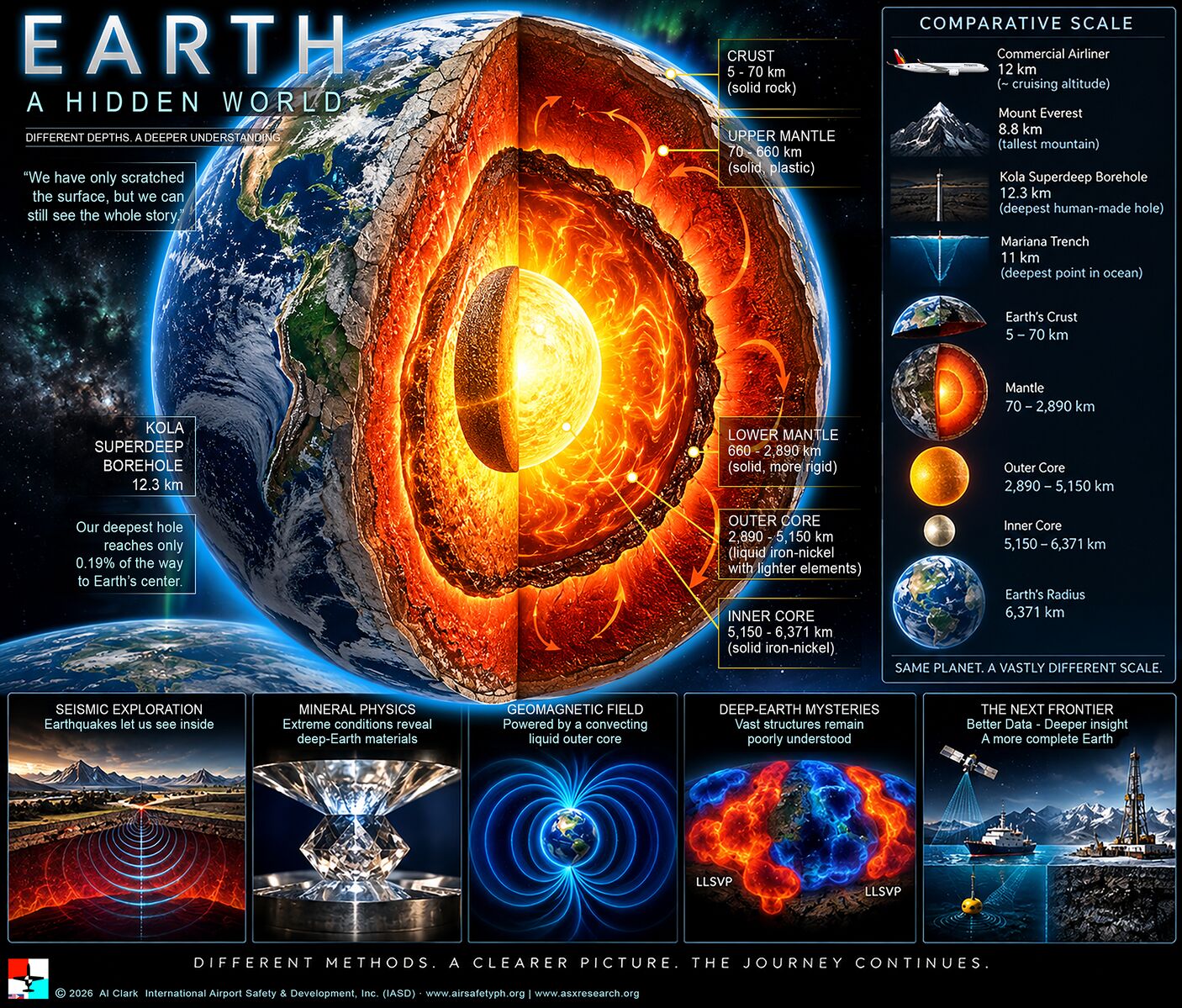
The most provocative fact about Earth’s interior is not that it contains a molten outer core, a solid inner core, or vast convecting rock hundreds to thousands of kilometers beneath us; it is that no human instrument has ever physically approached any of those regions. The Kola Superdeep Borehole, the extraordinary Soviet scientific project highlighted in the supplied YouTube material, reached a vertical depth of 12,262 meters—about 12.3 kilometers—yet Earth’s mean radius is roughly 6,371 kilometers. Humanity therefore penetrated only about 0.19% of the distance to the planetary center. The video captures the intellectual shock of that disparity particularly well: an engineering project conducted over decades barely scratched the outer crust, while textbooks confidently depict structures thousands of kilometers deeper. Modern scholarship confirms both the importance of Kola and the limitations it exposed; ultradeep drilling revealed fractured, fluid-bearing, thermally dynamic crystalline crust rather than the mechanically simple deep crust once imagined (Zhu & Huang, 2026). The correct lesson, however, is not that geophysicists are guessing blindly. It is more interesting: almost everything we know about deep Earth is the product of inference, and some of those inferences have become extraordinarily powerful. The challenge is distinguishing what has been directly sampled, what has been indirectly measured, what has been experimentally reproduced, and what remains model-dependent.
That intellectual architecture began long before anyone could contemplate a twelve- kilometer borehole. In 1909, Croatian seismologist Andrija Mohorovičić recognized that earthquake waves arriving at different speeds required a sharp change in material properties below the crust; the boundary now carrying his name, the Mohorovičić discontinuity or Moho, was discovered without being touched. Beno Gutenberg subsequently established the existence and approximate depth of the core–mantle boundary from seismic-wave behavior, while Inge Lehmann’s 1936 interpretation of earthquake arrivals led to the recognition of a solid inner core enclosed within a liquid outer core. The basic method remains astonishingly elegant. Earthquakes supply impulsive energy, and the planet itself becomes the experimental object: compressional P waves travel through solids and liquids, whereas shear S waves cannot propagate through fluids. Their travel times, refraction, reflection, attenuation, normal modes, and shadow zones reveal changes in density, elasticity, and phase. Adam M. Dziewonski and Don L. Anderson (1981) synthesized enormous quantities of such information into the Preliminary Reference Earth Model, or PREM, still one of the foundational one-dimensional descriptions of Earth’s radial density, seismic velocity, and attenuation structure. PREM is not a photograph of Earth; it is something in some ways more intellectually remarkable—a quantitatively testable reconstruction of an inaccessible planet derived from how Earth rings when struck by earthquakes.
The present model divides Earth mechanically and chemically into regions whose boundaries are constrained with varying degrees of precision. Beneath oceanic crust only several kilometers thick and continental crust commonly tens of kilometers thick lies the mantle, extending to approximately 2,890 kilometers depth. The liquid outer core continues from there to roughly 5,150 kilometers, and the solid inner core occupies the final approximately 1,220- kilometer radius to Earth’s center. Pressure climbs from one atmosphere at the surface to about 136 gigapascals at the core–mantle boundary and roughly 360 gigapascals near the center; temperatures rise into the thousands of kelvins. Crucially, the mantle is not a globe-spanning ocean of magma. It is overwhelmingly solid. Its rocks can nevertheless deform and flow over geological timescales because temperature, pressure, grain-scale creep, phase transformations, and immense periods of time allow solid material to behave viscously. That distinction matters: diagrams showing a glowing red mantle are pedagogically useful but visually dangerous because they encourage the false inference that red means liquid. Dziewonski and Anderson (1981) established the radial seismic framework upon which these depths and transitions are interpreted, while later mineral physics supplied the material explanation for why seismic velocities change at particular pressures. Earth is therefore better imagined not as a series of hollow shells filled with different substances, but as a pressure-driven continuum in which composition, crystal structure, temperature, phase, and mechanical behavior change profoundly with depth.
Why is Earth layered at all? The answer begins approximately 4.54 billion years ago during planetary accretion. Collisions among planetesimals, gravitational compression, impact heating, short-lived radioactive isotopes, and large-scale melting allowed early Earth to differentiate. Dense metallic iron, accompanied by nickel and elements chemically attracted to metal, migrated inward while oxygen-, silicon-, and magnesium-rich silicates became concentrated in the mantle and crust. William F. McDonough and Sun-sik Sun (1995) showed how cosmochemical evidence from meteorites, geochemical measurements of accessible terrestrial rocks, and geophysical constraints can be combined to estimate bulk Earth composition even though almost none of the planet can be sampled directly. Iron is therefore abundant in the core not simply because it is “heavy,” but because planetary differentiation chemically and gravitationally partitioned metallic and silicate reservoirs while Earth was hot enough for large-scale separation. The core is predominantly iron alloyed with nickel, but its measured density requires lighter constituents as well; oxygen, silicon, sulfur, carbon, and hydrogen remain leading candidates whose exact proportions are still debated. This is one of the first places where a textbook cutaway conceals genuine uncertainty. We know with high confidence that a metallic core exists. We know its approximate mass, dimensions, seismic velocities, and density. We do not possess a bottle of outer-core liquid to place in a laboratory analyzer, so its detailed chemistry must be reconstructed by making cosmochemistry, seismology, high-pressure experiments, and thermodynamics agree simultaneously.
The mantle becomes still more interesting because its boundaries are partly mineralogical rather than simply compositional. Increasing pressure rearranges atoms into denser crystal structures even when the bulk chemistry changes little. Olivine-dominated upper-mantle assemblages transform through high-pressure phases including wadsleyite and ringwoodite; around the 660-kilometer discontinuity, these structures break down into minerals stable in the lower mantle. Much of the lower mantle is thought to be dominated volumetrically by bridgmanite, a magnesium-silicate perovskite-structured mineral, together with ferropericlase and calcium-silicate phases. Near the bottom of the mantle, laboratory experiments produced another surprise. Motohiko Murakami et al. (2004) demonstrated that MgSiO3 perovskite transforms under extreme pressure into a denser “post-perovskite” phase under conditions appropriate to the lowermost mantle. That discovery provided a mineral-physics mechanism for some seismic complexity in the Dʺ region immediately above the core. The important philosophical point is that Earth’s unseen mineralogy is not inferred from seismic waves alone. Diamond-anvil cells compress microscopic samples to pressures comparable with those deep inside the planet; lasers heat them to thousands of degrees; synchrotron X-rays determine crystal structures; quantum-mechanical calculations test stability and elasticity. A seismic discontinuity observed globally can therefore be connected to a phase transition reproduced experimentally at approximately the pressure where that discontinuity occurs. This convergence of independent evidence is why some conclusions about inaccessible Earth are much stronger than the word inference might initially suggest.
If radial models describe Earth as an onion, seismic tomography reveals that the onion is spectacularly lopsided. Barbara Romanowicz (2003) reviewed the development of global mantle tomography, in which thousands of seismic ray paths are mathematically inverted to map three- dimensional variations in wave speed. Faster regions are generally—but not automatically— associated with colder or compositionally different material, while slower regions may indicate hotter, compositionally distinct, partially molten, or otherwise anomalous rock. Subducted lithosphere can descend hundreds or even thousands of kilometers into the mantle, linking surface plate tectonics to deep planetary circulation. At the opposite extreme, immense low- seismic-velocity structures occupy portions of the lowermost mantle beneath Africa and the Pacific. Edward J. Garnero et al. (2016) describe these large low-shear-velocity provinces, or LLSVPs, as continent-scale anomalies whose origin remains unresolved: they may be principally thermal structures, compositionally distinct ancient reservoirs, accumulations influenced by subduction, or combinations of these processes. Their sheer scale is difficult to exaggerate. They rise hundreds to more than a thousand kilometers above the core–mantle boundary and occupy enormous fractions of the deep mantle. Yet nobody has drilled into one, sampled one, or photographed one. Their existence is inferred because earthquake waves repeatedly behave as though those structures are there. Their exact composition, density, age, and role in mantle plumes remain active scientific questions—a perfect example of where “we know” and “we are still finding out” occupy the same sentence.
At approximately 2,890 kilometers depth lies perhaps the most violent material transition inside the planet: the core–mantle boundary. Solid silicate mantle meets convecting liquid metallic outer core across an interface where density increases dramatically and chemical, thermal, electrical, and mechanical properties change over an astonishingly short vertical distance. Thorne Lay et al. (1998) described this boundary region not as a passive dividing line but as a dynamic thermal and chemical boundary layer capable of coupling mantle convection to core behavior. The Dʺ region immediately above it contains strong seismic heterogeneity, post- perovskite, thin ultralow-velocity zones and possibly localized melts or chemically unusual material. Murakami et al. (2004) made the post-perovskite transition particularly important because its pressure stability overlaps conditions expected there. Garnero et al. (2016) further showed that the huge deep-mantle provinces terminate at this same planetary interface. Heat flowing out of the core is therefore not delivered uniformly into an abstract spherical mantle; it encounters an irregular geological landscape created by billions of years of mantle circulation. Cold subducted slabs may eventually alter heat extraction from the core, while hot deep structures may insulate portions of it. In this sense, a tectonic plate sinking beneath the Pacific can become part of a chain of events that eventually influences conditions almost 3,000 kilometers below the surface. Surface geology and the metallic core are separated spatially by the entire mantle but dynamically belong to the same planetary machine.
Below that interface the physics changes dramatically. The outer core is liquid, primarily iron alloyed with nickel and lighter elements, because temperature there exceeds the alloy’s melting temperature at the prevailing pressure; deeper still, increasing pressure eventually favors crystallization, creating the solid inner core. Kei Hirose et al. (2013) emphasize that the exact composition and thermal state of the core remain incompletely constrained despite major experimental advances. The outer core is also the engine of Earth’s geomagnetic field. Cooling from above, chemical buoyancy released as the inner core crystallizes, planetary rotation, electrically conducting liquid metal, and magnetohydrodynamic feedback combine to sustain the geodynamo. Gary A. Glatzmaier and Paul H. Roberts (1995) produced a landmark three- dimensional self-consistent numerical geodynamo simulation capable of sustaining an Earth-like magnetic field and spontaneously undergoing a polarity reversal, demonstrating that reversals need not require an external catastrophe. Earth’s magnetism therefore provides another observational window into otherwise invisible core motion. Satellites and observatories measure secular variation at the surface; mathematical field models extrapolate downward to the core– mantle boundary; fluid-dynamical and electromagnetic equations then constrain plausible outer- core flows. The result is powerful but not omniscient. We know that liquid-metal convection generates the field with extraordinary confidence, yet the detailed instantaneous flow pattern thousands of kilometers below us remains reconstructed rather than observed directly. The core is not a static iron ball. It is an electrically conducting planetary ocean whose motion leaves fingerprints in compasses, satellites, rocks, and the changing geometry of Earth’s magnetic field.
At approximately 5,150 kilometers depth the liquid outer core freezes inward to form the inner core, a sphere roughly 2,440 kilometers across. Pressure near the inner-core boundary is about 330 gigapascals, and temperature estimates generally lie near several thousand kelvins. That iron can remain solid under such conditions is not paradoxical: immense pressure raises the melting conditions sufficiently for crystallization. Shigehiko Tateno et al. (2010) compressed and heated iron experimentally and found hexagonal close-packed iron stable under pressures and temperatures approaching those of the inner core, providing important support for an hcp- dominated structure, although the exact stable crystal assemblage of the real multicomponent core remains debated. Seismology adds another complication. Arwen Deuss (2014) reviewed evidence that the inner core is anisotropic: seismic waves traveling approximately parallel to Earth’s rotational axis can propagate at different velocities from waves traveling equatorially. The pattern is neither perfectly uniform nor completely understood, suggesting crystallographic alignment, deformation, directional solidification, or some combination. Even the word solid therefore needs finesse. Solid does not mean rigid, perfectly homogeneous, motionless, or geologically immutable. At temperatures close to melting and under immense stress, the inner core can deform over time. Its surface may contain structure, its crystals may be preferentially aligned, and its growth may be asymmetric. The most inaccessible object on Earth is emerging not as a featureless metal sphere but as a textured, evolving geological body.
Recent research has made that body stranger still. Yi Yang and Xiaodong Song (2023) analyzed repeating seismic paths and argued that inner-core differential rotation varies on multidecadal timescales rather than proceeding as steady super-rotation. Wei Wang et al. (2024) then compiled repeating earthquakes spanning 1991–2023 and documented waveform changes that later reversed, consistent with the inner core first moving one way relative to the mantle and subsequently backtracking along the same relative orientation. This does not mean Earth’s core suddenly began spinning backward in an absolute astronomical sense; it concerns small differences between inner-core rotation and the mantle–crust reference frame. John E. Vidale et al. (2025) went further, finding evidence that temporal changes cannot all be explained by rotation alone. Their analysis indicates that the shallow inner core itself may deform on annual- to-decadal timescales, probably through viscous deformation near the inner-core boundary driven by interaction with the outer core and gravitational or topographic coupling. This is an extraordinary conceptual shift. Within one human lifetime, seismologists have progressed from debating whether the inner core rotates differently from the mantle to resolving changes in its relative motion and detecting probable changes in its near-surface shape. The deepest part of Earth, once represented as the simplest sphere in the textbook diagram, may actually be one of the most dynamically subtle components of the planet.
The energy sustaining all of this is another area where popular explanations frequently go wrong. Earth remains hot partly because it retained primordial energy from accretion, differentiation, gravitational segregation, and core formation, and partly because radioactive isotopes continue producing heat. Heat moves internally by conduction and convection and ultimately leaves Earth through its surface; the planet is not warm simply because heat can escape to space only by radiation. Nor is the central core thought to contain most of Earth’s uranium and thorium. Those elements are predominantly lithophile and concentrated within the silicate Earth rather than being massively segregated into the metallic core. Stephen T. Dye (2012) showed how geoneutrinos—electron antineutrinos emitted during radioactive decay chains—offer a fundamentally different way to constrain the abundance of heat-producing elements. William F. McDonough et al. (2020) calculated a present-day terrestrial radiogenic power near 20 terawatts under their preferred compositional framework, while emphasizing uncertainties in inventories and distributions. This matters because Earth’s total surface heat loss is roughly twice that order of magnitude, meaning primordial cooling and radiogenic heating both contribute significantly to the modern thermal engine. The balance influences mantle convection, volcanism, plate tectonics, core cooling, inner-core growth, and ultimately geodynamo evolution. Geoneutrinos are therefore remarkable messengers: particles produced inside inaccessible rock pass through the entire planet essentially unimpeded and can be detected at the surface, giving us information about chemistry from regions no drill will ever reach.
This leads to the most important question: how certain is the picture? Deep-Earth science is an inverse problem. Researchers observe seismic travel times, free oscillations, gravity, magnetic fields, geochemical abundances, heat flux, neutrinos, and high-pressure material properties, then seek interior structures capable of producing those observations. Inverse problems can be non-unique: different combinations of temperature, composition, crystal orientation, melt fraction, or geometry may generate similar signals. Romanowicz (2003) made clear that seismic tomography has finite spatial resolution and uneven ray coverage; Garnero et al. (2016) showed that even enormous and robustly detected mantle anomalies retain uncertain composition and origin; Hirose et al. (2013) documented persistent uncertainty in core chemistry despite dramatic experimental progress. That does not reduce deep-Earth science to speculation. Quite the opposite: its strongest conclusions survive multiple independent tests. A liquid outer core is supported by S-wave absence, P-wave propagation, normal modes, density, geomagnetism, thermodynamics, and experiments. The exact oxygen-versus-silicon-versus- hydrogen inventory of that liquid is much less certain. The existence of enormous basal-mantle seismic anomalies is secure; whether they are primarily thermal, chemical, primordial, recycled, or mixed remains unsettled. Scientific honesty therefore requires assigning confidence at the level of individual propositions instead of stamping an entire cutaway diagram “known.” The remarkable achievement of geophysics is not that it has eliminated uncertainty but that it has quantified an enormous invisible world while continually exposing exactly where its uncertainty resides.
Where does the exploration go next? Paradoxically, both deeper drilling and methods requiring no drilling at all are advancing simultaneously. Guangyou Zhu and Haiping Huang (2026) review a new generation of ultradeep boreholes exceeding ten kilometers and emphasize that improvements in drilling, downhole measurement, temperature tolerance, materials, and real-time characterization are turning extreme crustal depths into scientific laboratories rather than record-setting curiosities. Yet even a revolutionary twenty-kilometer continental borehole would remain nowhere near the mantle in most continental settings, let alone the core. The deeper revolution will therefore come from denser global seismic arrays, ocean-bottom seismometers, repeating-earthquake analysis, improved normal-mode observations, satellite gravimetry and geomagnetism, neutrino detectors, vastly more capable numerical inversions, machine-assisted pattern recognition, and laboratory experiments that reproduce hundreds of gigapascals and thousands of kelvins. Diamond-anvil cells and synchrotron facilities will continue closing the gap between theoretical mineral physics and seismic observations. Geoneutrino measurements may constrain the mantle’s radiogenic budget far better than crust- dominated continental detectors currently permit. Repeating earthquakes may allow researchers to watch the inner core evolve almost as though nature had installed a time-lapse camera 5,000 kilometers below us. The future of inner-Earth exploration will therefore not be a single heroic shaft drilled toward the center. It will be a distributed planetary observatory in which earthquakes, particles, magnetic fields, gravity, computation, and extreme-pressure experiments progressively sharpen an image that can never be photographed conventionally.
The deepest lesson is consequently both humbling and exhilarating. We have touched only the thinnest fraction of Earth, yet we can calculate the radius of an inner core more than 5,000 kilometers beneath us, determine that the surrounding outer core is liquid, infer crystallographic textures inside solid iron, map continent-sized structures resting above the core, reconstruct descending tectonic slabs, measure radioactive decay products emerging from the mantle, and now detect changes in inner-core rotation and probable deformation over intervals measured in years. None of this grants permission to mistake models for photographs. The familiar colored concentric circles in a schoolbook are an extraordinary compression of thousands of earthquakes, laboratory experiments, thermodynamic equations, meteorites, magnetic observations, gravity measurements, neutrinos, and more than a century of argument. The Kola borehole remains the perfect reality check because its 12.262 kilometers simultaneously represents one of humanity’s greatest direct achievements in Earth exploration and almost nothing on the scale of the planet. What lies beneath us today is not simply crust, mantle, outer core, and inner core; it is an active coupled system carrying the memory of planetary formation while continually evolving beneath our feet. The next great discovery may alter a mineral phase, redraw a mantle structure, change an estimate of core composition, or reveal that the inner core is even more dynamic than presently believed. We will almost certainly never stand there. We may nevertheless come astonishingly close to understanding it. And that may be the most earth-shaking fact of all.
References
Deuss, A. (2014). Heterogeneity and anisotropy of Earth’s inner core. Annual Review of Earth and Planetary Sciences, 42, 103–126. https://doi.org/10.1146/annurev-earth- 060313-054658
Dye, S. T. (2012). Geoneutrinos and the radioactive power of the Earth. Reviews of Geophysics, 50(3), RG3007. https://doi.org/10.1029/2012RG000400
Dziewonski, A. M., & Anderson, D. L. (1981). Preliminary reference Earth model. Physics of the Earth and Planetary Interiors, 25(4), 297–356. https://doi.org/10.1016/0031-9201(81)90046-7
Garnero, E. J., McNamara, A. K., & Shim, S.-H. D. (2016). Continent-sized anomalous zones with low seismic velocity at the base of Earth’s mantle. Nature Geoscience, 9, 481–489. https://doi.org/10.1038/ngeo2733
Glatzmaier, G. A., & Roberts, P. H. (1995). A three-dimensional self-consistent computer simulation of a geomagnetic field reversal. Nature, 377, 203–209. https://doi.org/10.1038/377203a0
Hirose, K., Labrosse, S., & Hernlund, J. (2013). Composition and state of the core. Annual Review of Earth and Planetary Sciences, 41, 657–691. https://doi.org/10.1146/annurev-earth-050212-124007
Lay, T., Williams, Q., & Garnero, E. J. (1998). The core–mantle boundary layer and deep Earth dynamics. Nature, 392(6675), 461–468. https://doi.org/10.1038/33083
McDonough, W. F., Šrámek, O., & Wipperfurth, S. A. (2020). Radiogenic power and geoneutrino luminosity of the Earth and other terrestrial bodies through time. Geochemistry, Geophysics, Geosystems, 21, e2019GC008865. https://doi.org/10.1029/2019GC008865
McDonough, W. F., & Sun, S.-s. (1995). The composition of the Earth. Chemical Geology, 120(3–4), 223–253. https://doi.org/10.1016/0009-2541(94)00140-4
Murakami, M., Hirose, K., Kawamura, K., Sata, N., & Ohishi, Y. (2004). Post-perovskite phase transition in MgSiO3. Science, 304(5672), 855–858. https://doi.org/10.1126/science.1095932
Romanowicz, B. (2003). Global mantle tomography: Progress status in the past 10 years. Annual Review of Earth and Planetary Sciences, 31, 303–328. https://doi.org/10.1146/annurev.earth.31.091602.113555
Tateno, S., Hirose, K., Ohishi, Y., & Tatsumi, Y. (2010). The structure of iron in Earth’s inner core. Science, 330(6002), 359–361. https://doi.org/10.1126/science.1194662
Vidale, J. E., Wang, W., Wang, R., Pang, G., & Koper, K. (2025). Annual-scale variability in both the rotation rate and near surface of Earth’s inner core. Nature Geoscience, 18, 267–272. https://doi.org/10.1038/s41561-025-01642-2
Wang, W., Vidale, J. E., Pang, G., Koper, K. D., & Wang, R. (2024). Inner core backtracking by seismic waveform change reversals. Nature, 631, 340–343. https://doi.org/10.1038/s41586-024-07536-4
Yang, Y., & Song, X. (2023). Multidecadal variation of the Earth’s inner-core rotation. Nature Geoscience, 16, 182–187. https://doi.org/10.1038/s41561-022-01112-z
Zhu, G., & Huang, H. (2026). Ultradeep drilling beyond 10 km revealing new insights into Earth systems and resources. Communications Earth & Environment, 7, Article 124. https://doi.org/10.1038/s43247-026-03246-z
Buong Teksto / Transkripsiyon ng Artikulo 
Ang Planetang Hindi Pa Natin Nakikita: Ano ang Nasa Ilalim ng Daigdig, Paano Natin Ito Nalalaman, at Saan Patungo ang Paghahanap
Albert N. Clark
Independent Author
Inilathala: Setyembre 8, 2026
ASX Research Journal and Database
ISSN 3068-3351 (Online)
Lugar ng Paglalathala: Cadiz City, Philippines
Publisher: ASXResearch.org
Tala ng May-akda
Albert N. Clark
Department of Aerospace Sciences, ASXResearch.org
ORCID iD: https://orcid.org/0009-0002-7348-4395
Walang iniulat na salungatan ng interes ang may-akda.
Ang mga liham hinggil sa artikulong ito ay dapat ipadala kay Albert N. Clark, Email: [email protected]
Abstrak
Direktang narating ng sangkatauhan ang napakaliit lamang na bahagi ng Daigdig, ngunit nakabuo ang modernong geophysics ng lalong sopistikadong modelo ng mga estrukturang umaabot nang mahigit 6,000 kilometro sa ilalim ng ibabaw. Sinusuri ng pag-aaral na ito ang kasalukuyang pagkaunawa sa interior ng Daigdig mula sa crust at mantle, sa core–mantle boundary, liquid outer core, at solid inner core, habang kritikal na pinag-iiba ang direktang obserbasyon at ang inference na mahigpit na nililimitahan ng siyentipikong ebidensiya. Simula sa Kola Superdeep Borehole bilang sukatan ng mga hangganan ng pisikal na eksplorasyon, tinutunton ng pagsusuri kung paano sama-samang inilalantad ng seismology, mineral physics, geomagnetism, geochemistry, high-pressure experimentation, geoneutrino detection, at computational modeling ang isang planetary environment na hindi direktang naaabot. Partikular na binibigyang-pansin ang mantle convection at phase transitions, large low-shear-velocity provinces, komposisyon at dynamics ng core, ang geodynamo, inner-core anisotropy, differential rotation, at umuusbong na ebidensiya ng inner-core deformation. Sinusuri rin ng pag-aaral ang mga uncertainty na natatakpan ng pinasimpleng textbook representations ng Daigdig at isinasaalang-alang kung paano maaaring baguhin ng ultradeep drilling, pinahusay na seismic networks, particle detection, laboratory experimentation, at advanced computational methods ang deep-Earth science. Ipinakikita ng ebidensiya na bagaman maaaring hindi kailanman pisikal na marating ng sangkatauhan ang mantle o core, ang magkakatugmang independent measurements ay nagbibigay-daan sa lalong eksaktong reconstruction ng mga rehiyong ito habang sabay na inilalantad ang isang planetang higit na dynamic, heterogeneous, at uncertain kaysa sa ipinahihiwatig ng karaniwang layered diagrams.
Mga Susing Salita: Deep Earth; Interior ng Daigdig; Seismology; Inner Core
Ang Planetang Hindi Pa Natin Nakikita: Ano ang Nasa Ilalim ng Daigdig, Paano Natin Ito Nalalaman, at Saan Patungo ang Paghahanap
Ang pinakanakapupukaw na katotohanan tungkol sa interior ng Daigdig ay hindi na mayroon itong molten outer core, solid inner core, o napakalawak na convecting rock na daan-daan hanggang libu-libong kilometro sa ilalim natin; kundi wala pang instrumentong gawa ng tao ang pisikal na nakalapit sa alinman sa mga rehiyong iyon. Ang Kola Superdeep Borehole, ang pambihirang Soviet scientific project na itinampok sa ibinigay na YouTube material, ay umabot sa vertical depth na 12,262 metro—humigit-kumulang 12.3 kilometro—samantalang ang mean radius ng Daigdig ay humigit-kumulang 6,371 kilometro. Samakatuwid, nakapasok lamang ang sangkatauhan nang mga 0.19% ng distansiya patungo sa sentro ng planeta. Napakahusay na naipakikita ng video ang intellectual shock ng agwat na iyon: ang isang engineering project na isinagawa sa loob ng ilang dekada ay bahagya lamang nakagasgas sa panlabas na crust, habang may kumpiyansang inilalarawan ng mga textbook ang mga estrukturang libu-libong kilometro ang lalim. Pinatutunayan ng modernong scholarship kapwa ang kahalagahan ng Kola at ang mga limitasyong inilantad nito; ipinakita ng ultradeep drilling ang fractured, fluid-bearing, thermally dynamic crystalline crust sa halip na ang mechanically simple deep crust na minsang ipinapalagay (Zhu & Huang, 2026). Gayunman, ang tamang aral ay hindi na nanghuhula lamang nang bulag ang mga geophysicist. Mas kawili-wili rito ang katotohanan: halos lahat ng nalalaman natin tungkol sa deep Earth ay bunga ng inference, at ang ilan sa mga inference na iyon ay naging pambihirang makapangyarihan. Ang hamon ay ang malinaw na pagkilala kung ano ang direktang nasampolan, ano ang hindi direktang nasukat, ano ang muling nalikha sa eksperimento, at ano ang nananatiling nakadepende sa modelo.
Nagsimula ang intellectual architecture na iyon bago pa man maisip ng sinuman ang isang labindalawang-kilometrong borehole. Noong 1909, napansin ng Croatian seismologist na si Andrija Mohorovičić na ang earthquake waves na dumarating sa magkakaibang bilis ay nangangailangan ng matinding pagbabago sa material properties sa ilalim ng crust; natuklasan ang boundary na ngayo’y nagtataglay ng kanyang pangalan, ang Mohorovičić discontinuity o Moho, nang hindi kailanman nahahawakan. Kalaunan ay itinatag ni Beno Gutenberg ang pag-iral at tinatayang lalim ng core–mantle boundary mula sa kilos ng seismic waves, samantalang ang interpretasyon ni Inge Lehmann noong 1936 sa earthquake arrivals ay humantong sa pagkilala sa isang solid inner core na nakapaloob sa liquid outer core. Nananatiling kahanga-hangang elegante ang pangunahing pamamaraan. Nagbibigay ang mga lindol ng impulsive energy, at ang planeta mismo ang nagiging experimental object: ang compressional P waves ay dumaraan sa solids at liquids, samantalang ang shear S waves ay hindi makapagpropagate sa fluids. Ang kanilang travel times, refraction, reflection, attenuation, normal modes, at shadow zones ay nagbubunyag ng mga pagbabago sa density, elasticity, at phase. Pinagsama nina Adam M. Dziewonski at Don L. Anderson (1981) ang napakaraming ganitong impormasyon sa Preliminary Reference Earth Model, o PREM, na nananatiling isa sa mga foundational one-dimensional descriptions ng radial density, seismic velocity, at attenuation structure ng Daigdig. Ang PREM ay hindi litrato ng Daigdig; sa ilang paraan ay mas kahanga-hanga pa ito sa intelektuwal na pananaw—isang quantitatively testable reconstruction ng isang hindi naaabot na planeta na hinango mula sa paraan ng pag-alingawngaw ng Daigdig kapag tinatamaan ng mga lindol.
Hinahati ng kasalukuyang modelo ang Daigdig, sa mechanical at chemical na paraan, sa mga rehiyong ang boundaries ay nalilimitahan nang may magkakaibang antas ng precision. Sa ilalim ng oceanic crust na ilang kilometro lamang ang kapal at continental crust na karaniwang umaabot sa ilang sampung kilometro ay naroon ang mantle, na umaabot hanggang humigit-kumulang 2,890 kilometro ang lalim. Mula roon ay nagpapatuloy ang liquid outer core hanggang humigit-kumulang 5,150 kilometro, at sinasakop ng solid inner core ang huling humigit-kumulang 1,220-kilometrong radius patungo sa sentro ng Daigdig. Tumataas ang pressure mula sa isang atmosphere sa ibabaw hanggang mga 136 gigapascals sa core–mantle boundary at humigit-kumulang 360 gigapascals malapit sa sentro; umaabot naman ang temperatures sa libu-libong kelvins. Mahalaga: ang mantle ay hindi isang globe-spanning ocean ng magma. Halos kabuuan nito ay solid. Gayunman, maaaring ma-deform at dumaloy ang mga bato nito sa geological timescales dahil pinahihintulutan ng temperature, pressure, grain-scale creep, phase transformations, at napakahahabang panahon ang solid material na kumilos nang viscously. Mahalaga ang distinction na iyon: kapaki-pakinabang sa pagtuturo ang diagrams na nagpapakita ng glowing red mantle ngunit mapanganib sa visual interpretation dahil madaling isipin na ang pula ay nangangahulugang liquid. Itinatag nina Dziewonski at Anderson (1981) ang radial seismic framework kung saan binibigyang-kahulugan ang mga depth at transition na ito, habang nagbigay ang sumunod na mineral physics ng material explanation kung bakit nagbabago ang seismic velocities sa partikular na pressures. Kaya mas angkop isipin ang Daigdig hindi bilang serye ng hollow shells na puno ng magkakaibang substances, kundi bilang pressure-driven continuum kung saan malalim na nagbabago ang composition, crystal structure, temperature, phase, at mechanical behavior habang lumalalim.
Bakit layered ang Daigdig? Nagsisimula ang sagot humigit-kumulang 4.54 bilyong taon na ang nakalipas sa panahon ng planetary accretion. Ang banggaan ng planetesimals, gravitational compression, impact heating, short-lived radioactive isotopes, at large-scale melting ay nagbigay-daan upang mag-differentiate ang sinaunang Daigdig. Ang dense metallic iron, kasama ang nickel at mga elementong chemically attracted sa metal, ay lumipat paloob habang ang oxygen-, silicon-, at magnesium-rich silicates ay naging concentrated sa mantle at crust. Ipinakita nina William F. McDonough at Sun-sik Sun (1995) kung paano maaaring pagsamahin ang cosmochemical evidence mula sa meteorites, geochemical measurements ng naaabot na terrestrial rocks, at geophysical constraints upang matantiya ang bulk Earth composition kahit halos wala sa planeta ang direktang nasasampolan. Kaya sagana ang iron sa core hindi lamang dahil “mabigat” ito, kundi dahil chemically at gravitationally na pinaghiwalay ng planetary differentiation ang metallic at silicate reservoirs habang sapat ang init ng Daigdig para sa large-scale separation. Pangunahing iron na alloyed with nickel ang core, ngunit nangangailangan ang measured density nito ng mas magagaan na constituents; nananatiling pangunahing kandidato ang oxygen, silicon, sulfur, carbon, at hydrogen, bagaman pinagtatalunan pa ang eksaktong proportions. Isa ito sa mga unang lugar kung saan nagtatago ng tunay na uncertainty ang textbook cutaway. Alam natin nang may mataas na confidence na may metallic core. Alam natin ang tinatayang mass, dimensions, seismic velocities, at density nito. Wala tayong bote ng outer-core liquid na mailalagay sa laboratory analyzer, kaya kailangang i-reconstruct ang detalyadong chemistry nito sa pamamagitan ng sabay-sabay na pagpapatugma sa cosmochemistry, seismology, high-pressure experiments, at thermodynamics.
Lalong nagiging kawili-wili ang mantle dahil ang boundaries nito ay bahagyang mineralogical sa halip na simpleng compositional. Habang tumataas ang pressure, muling inaayos ang mga atom sa mas dense na crystal structures kahit kaunti lamang ang pagbabago sa bulk chemistry. Ang olivine-dominated upper-mantle assemblages ay nagta-transform sa high-pressure phases kabilang ang wadsleyite at ringwoodite; sa paligid ng 660-kilometer discontinuity, nababasag ang mga structure na ito at nagiging minerals na stable sa lower mantle. Pinaniniwalaang malaking bahagi ng lower mantle ay volumetrically dominated ng bridgmanite, isang magnesium-silicate perovskite-structured mineral, kasama ang ferropericlase at calcium-silicate phases. Malapit sa ilalim ng mantle, nagbigay ang laboratory experiments ng isa pang sorpresa. Ipinakita ni Motohiko Murakami et al. (2004) na ang MgSiO3 perovskite ay nagta-transform sa ilalim ng extreme pressure tungo sa mas dense na “post-perovskite” phase sa conditions na angkop sa lowermost mantle. Nagbigay ang discovery na iyon ng mineral-physics mechanism para sa ilang seismic complexity sa Dʺ region kaagad sa ibabaw ng core. Ang mahalagang philosophical point ay hindi lamang mula sa seismic waves ini-infer ang unseen mineralogy ng Daigdig. Kino-compress ng diamond-anvil cells ang microscopic samples hanggang sa pressures na maihahambing sa deep interior ng planeta; pinaiinit ito ng lasers sa libu-libong degrees; tinutukoy ng synchrotron X-rays ang crystal structures; at sinusubok ng quantum-mechanical calculations ang stability at elasticity. Kaya maaaring iugnay ang isang seismic discontinuity na nakikita sa buong mundo sa isang phase transition na muling nalilikha sa laboratoryo sa humigit-kumulang parehong pressure kung saan umiiral ang discontinuity. Ang convergence na ito ng independent evidence ang dahilan kung bakit ang ilang conclusions tungkol sa inaccessible Earth ay higit na matibay kaysa sa unang ipinahihiwatig ng salitang inference.
Kung inilalarawan ng radial models ang Daigdig bilang isang sibuyas, ipinakikita ng seismic tomography na napakalayo nito sa pagiging simetriko. Sinuri ni Barbara Romanowicz (2003) ang pag-unlad ng global mantle tomography, kung saan mathematically ini-invert ang libu-libong seismic ray paths upang imapa ang three-dimensional variations sa wave speed. Ang faster regions ay karaniwang—ngunit hindi awtomatikong—inuugnay sa mas malamig o compositionally different material, samantalang ang slower regions ay maaaring magpahiwatig ng mas mainit, compositionally distinct, partially molten, o iba pang anomalous rock. Maaaring lumubog ang subducted lithosphere nang daan-daan o maging libu-libong kilometro sa mantle, na nag-uugnay sa surface plate tectonics at deep planetary circulation. Sa kabilang sukdulan, napakalalaking low-seismic-velocity structures ang sumasakop sa mga bahagi ng lowermost mantle sa ilalim ng Africa at Pacific. Inilalarawan nina Edward J. Garnero et al. (2016) ang large low-shear-velocity provinces, o LLSVPs, bilang continent-scale anomalies na hindi pa tiyak ang pinagmulan: maaaring pangunahing thermal structures ang mga ito, compositionally distinct ancient reservoirs, accumulations na naimpluwensiyahan ng subduction, o kombinasyon ng mga prosesong ito. Mahirap palakihin pa sa salita ang kanilang scale. Umaangat sila nang daan-daan hanggang higit isang libong kilometro mula sa core–mantle boundary at sumasakop sa napakalaking bahagi ng deep mantle. Gayunman, walang sinumang nakapag-drill, nakapagsample, o nakakuha ng litrato ng isa sa mga ito. Ini-infer ang kanilang pag-iral dahil paulit-ulit na kumikilos ang earthquake waves na para bang naroon ang mga structure na iyon. Ang eksaktong composition, density, age, at papel nila sa mantle plumes ay nananatiling aktibong scientific questions—isang perpektong halimbawa kung saan sabay na totoo ang “alam natin” at “patuloy pa nating inaalam.”
Sa humigit-kumulang 2,890 kilometro ang lalim ay naroon marahil ang pinakamarahas na material transition sa loob ng planeta: ang core–mantle boundary. Dito nagtatagpo ang solid silicate mantle at convecting liquid metallic outer core sa isang interface kung saan dramatikong tumataas ang density at nagbabago ang chemical, thermal, electrical, at mechanical properties sa napakaikling vertical distance. Inilarawan nina Thorne Lay et al. (1998) ang boundary region na ito hindi bilang passive dividing line kundi bilang dynamic thermal at chemical boundary layer na kayang i-couple ang mantle convection sa core behavior. Ang Dʺ region kaagad sa ibabaw nito ay may strong seismic heterogeneity, post-perovskite, manipis na ultralow-velocity zones, at posibleng localized melts o chemically unusual material. Ginawang partikular na mahalaga nina Murakami et al. (2004) ang post-perovskite transition dahil ang pressure stability nito ay nag-o-overlap sa conditions na inaasahan doon. Ipinakita pa nina Garnero et al. (2016) na ang malalaking deep-mantle provinces ay nagtatapos sa parehong planetary interface. Kaya hindi pantay na naihahatid ang heat na lumalabas mula sa core patungo sa isang abstract spherical mantle; nakakaharap nito ang irregular geological landscape na nilikha ng bilyun-bilyong taon ng mantle circulation. Maaaring baguhin kalaunan ng cold subducted slabs ang heat extraction mula sa core, samantalang maaaring i-insulate ng hot deep structures ang ilang bahagi nito. Sa ganitong diwa, ang tectonic plate na lumulubog sa ilalim ng Pacific ay maaaring maging bahagi ng chain of events na kalauna’y nakaaapekto sa conditions halos 3,000 kilometro sa ilalim ng ibabaw. Spatially, pinaghiwalay ng buong mantle ang surface geology at metallic core, ngunit dynamically bahagi sila ng iisang planetary machine.
Sa ibaba ng interface na iyon, dramatikong nagbabago ang physics. Liquid ang outer core, pangunahing iron na alloyed with nickel at lighter elements, dahil mas mataas doon ang temperature kaysa sa melting temperature ng alloy sa umiiral na pressure; mas malalim pa, kalaunan ay pinapaboran ng tumataas na pressure ang crystallization, kaya nabubuo ang solid inner core. Binibigyang-diin nina Kei Hirose et al. (2013) na hindi pa ganap na nalilimitahan ang eksaktong composition at thermal state ng core sa kabila ng malalaking experimental advances. Ang outer core rin ang engine ng geomagnetic field ng Daigdig. Ang cooling mula sa itaas, chemical buoyancy na nailalabas habang nagki-crystallize ang inner core, planetary rotation, electrically conducting liquid metal, at magnetohydrodynamic feedback ay nagsasama upang mapanatili ang geodynamo. Nakagawa sina Gary A. Glatzmaier at Paul H. Roberts (1995) ng landmark three-dimensional self-consistent numerical geodynamo simulation na kayang magpanatili ng Earth-like magnetic field at kusang sumailalim sa polarity reversal, na nagpapakitang hindi kailangan ng external catastrophe upang magkaroon ng reversals. Kaya nagbibigay ang magnetism ng Daigdig ng isa pang observational window sa invisible core motion. Sinusukat ng satellites at observatories ang secular variation sa surface; mathematically ine-extrapolate ng field models pababa sa core–mantle boundary; at nililimitahan naman ng fluid-dynamical at electromagnetic equations ang plausible outer-core flows. Makapangyarihan ang resulta ngunit hindi omniscient. Alam natin nang may pambihirang confidence na liquid-metal convection ang lumilikha ng field, ngunit reconstructed pa rin sa halip na direktang observed ang detalyadong instantaneous flow pattern libu-libong kilometro sa ilalim natin. Hindi static iron ball ang core. Isa itong electrically conducting planetary ocean na ang galaw ay nag-iiwan ng fingerprints sa compasses, satellites, rocks, at nagbabagong geometry ng magnetic field ng Daigdig.
Sa humigit-kumulang 5,150 kilometro ang lalim, nagyeyelo paloob ang liquid outer core upang mabuo ang inner core, isang sphere na humigit-kumulang 2,440 kilometro ang diameter. Ang pressure malapit sa inner-core boundary ay mga 330 gigapascals, at ang temperature estimates ay karaniwang nasa ilang libong kelvins. Hindi paradoxical na nananatiling solid ang iron sa gayong conditions: sapat na itinataas ng napakalaking pressure ang melting conditions upang magkaroon ng crystallization. Eksperimental na kino-compress at pinainit nina Shigehiko Tateno et al. (2010) ang iron at natuklasang stable ang hexagonal close-packed iron sa pressures at temperatures na lumalapit sa conditions ng inner core, na nagbibigay ng mahalagang suporta sa hcp-dominated structure, bagaman pinagtatalunan pa ang eksaktong stable crystal assemblage ng tunay na multicomponent core. Nagdaragdag ang seismology ng isa pang complication. Sinuri ni Arwen Deuss (2014) ang ebidensiyang anisotropic ang inner core: maaaring magpropagate sa magkaibang velocities ang seismic waves na naglalakbay halos parallel sa rotational axis ng Daigdig at yaong naglalakbay equatorially. Hindi perfectly uniform o lubos na nauunawaan ang pattern, na nagmumungkahi ng crystallographic alignment, deformation, directional solidification, o kombinasyon ng mga ito. Kaya maging ang salitang solid ay nangangailangan ng finesse. Ang solid ay hindi nangangahulugang rigid, perfectly homogeneous, motionless, o geologically immutable. Sa temperatures na malapit sa melting at sa ilalim ng napakalaking stress, maaaring ma-deform ang inner core sa paglipas ng panahon. Maaaring may structure ang surface nito, preferentially aligned ang crystals nito, at asymmetric ang growth nito. Ang pinakahindi naaabot na object sa Daigdig ay lumilitaw hindi bilang featureless metal sphere kundi bilang textured at evolving geological body.
Ginawang mas kakaiba pa ng recent research ang body na iyon. Sinuri nina Yi Yang at Xiaodong Song (2023) ang repeating seismic paths at ipinangatwirang nagbabago ang inner-core differential rotation sa multidecadal timescales sa halip na tuluy-tuloy na steady super-rotation. Pagkatapos ay pinagsama nina Wei Wang et al. (2024) ang repeating earthquakes mula 1991–2023 at naitala ang waveform changes na kalauna’y nag-reverse, na consistent sa inner core na unang gumagalaw sa isang direksiyon relative sa mantle at pagkatapos ay bumabalik sa parehong relative orientation. Hindi nito ibig sabihin na biglang nagsimulang umikot pabalik ang core ng Daigdig sa absolute astronomical sense; tumutukoy ito sa maliliit na differences sa pagitan ng inner-core rotation at mantle–crust reference frame. Higit pa rito, natuklasan nina John E. Vidale et al. (2025) na hindi maipapaliwanag ng rotation lamang ang lahat ng temporal changes. Ipinahihiwatig ng kanilang analysis na maaaring mismong ma-deform ang shallow inner core sa annual-to-decadal timescales, marahil sa pamamagitan ng viscous deformation malapit sa inner-core boundary na hinihimok ng interaction sa outer core at gravitational o topographic coupling. Isa itong pambihirang conceptual shift. Sa loob lamang ng isang human lifetime, umusad ang seismology mula sa debate kung umiikot ba nang naiiba ang inner core kumpara sa mantle tungo sa pag-resolve ng pagbabago sa relative motion nito at pag-detect ng probable changes sa near-surface shape nito. Ang pinakamalalim na bahagi ng Daigdig, na minsang inilalarawan bilang pinakasimpleng sphere sa textbook diagram, ay maaaring isa pala sa pinaka-dynamically subtle na components ng planeta.
Isa pang larangan kung saan madalas nagkakamali ang popular explanations ay ang energy na nagpapanatili sa lahat ng ito. Nananatiling mainit ang Daigdig partly dahil pinanatili nito ang primordial energy mula sa accretion, differentiation, gravitational segregation, at core formation, at partly dahil patuloy na lumilikha ng heat ang radioactive isotopes. Gumagalaw ang heat sa loob sa pamamagitan ng conduction at convection at kalauna’y lumalabas sa surface; hindi mainit ang planeta dahil lamang radiation ang tanging paraan upang makatakas ang heat patungo sa space. Hindi rin pinaniniwalaang nasa central core ang karamihan ng uranium at thorium ng Daigdig. Ang mga elementong iyon ay predominantly lithophile at concentrated sa silicate Earth sa halip na massively segregated sa metallic core. Ipinakita ni Stephen T. Dye (2012) kung paano nagbibigay ang geoneutrinos—electron antineutrinos na inilalabas sa radioactive decay chains—ng fundamentally different na paraan upang limitahan ang abundance ng heat-producing elements. Kinuwenta nina William F. McDonough et al. (2020) ang present-day terrestrial radiogenic power na malapit sa 20 terawatts sa kanilang preferred compositional framework, habang binibigyang-diin ang uncertainties sa inventories at distributions. Mahalaga ito dahil ang total surface heat loss ng Daigdig ay halos dalawang beses ng order of magnitude na iyon, ibig sabihin kapwa malaking contributor sa modern thermal engine ang primordial cooling at radiogenic heating. Nakaaapekto ang balance sa mantle convection, volcanism, plate tectonics, core cooling, inner-core growth, at kalaunan sa geodynamo evolution. Kaya kahanga-hangang messengers ang geoneutrinos: ang particles na nalilikha sa inaccessible rock ay dumaraan sa buong planeta nang halos walang hadlang at nade-detect sa surface, na nagbibigay sa atin ng impormasyon tungkol sa chemistry mula sa mga rehiyong hindi maaabot ng anumang drill.
Humahantong ito sa pinakamahalagang tanong: gaano katiyak ang larawang ito? Isang inverse problem ang deep-Earth science. Ino-observe ng researchers ang seismic travel times, free oscillations, gravity, magnetic fields, geochemical abundances, heat flux, neutrinos, at high-pressure material properties, pagkatapos ay naghahanap ng interior structures na kayang lumikha ng mga observation na iyon. Maaaring non-unique ang inverse problems: maaaring makabuo ng magkatulad na signals ang iba’t ibang combinations ng temperature, composition, crystal orientation, melt fraction, o geometry. Nilinaw ni Romanowicz (2003) na may finite spatial resolution at uneven ray coverage ang seismic tomography; ipinakita nina Garnero et al. (2016) na kahit napakalalaki at robustly detected na mantle anomalies ay may uncertain composition at origin; at idinokumento nina Hirose et al. (2013) ang persistent uncertainty sa core chemistry sa kabila ng dramatic experimental progress. Hindi nito binababa ang deep-Earth science sa speculation. Sa kabaligtaran, nakaliligtas sa maraming independent tests ang pinakamalalakas nitong conclusions. Ang liquid outer core ay sinusuportahan ng S-wave absence, P-wave propagation, normal modes, density, geomagnetism, thermodynamics, at experiments. Higit na hindi tiyak ang eksaktong oxygen-versus-silicon-versus-hydrogen inventory ng liquid na iyon. Secure ang existence ng napakalalaking basal-mantle seismic anomalies; nananatiling unsettled kung pangunahing thermal, chemical, primordial, recycled, o mixed ang mga ito. Kaya nangangailangan ang scientific honesty ng pag-assign ng confidence sa level ng individual propositions sa halip na tatakan ang buong cutaway diagram bilang “known.” Ang kahanga-hangang achievement ng geophysics ay hindi na inalis nito ang uncertainty, kundi na-quantify nito ang napakalaking invisible world habang patuloy na malinaw na inilalantad kung saan mismo nananatili ang uncertainty.
Saan patungo ang exploration? Paradoxically, sabay na umuunlad ang deeper drilling at mga paraang hindi nangangailangan ng drilling. Sinuri nina Guangyou Zhu at Haiping Huang (2026) ang bagong generation ng ultradeep boreholes na lumalampas sa sampung kilometro at binigyang-diin na ang improvements sa drilling, downhole measurement, temperature tolerance, materials, at real-time characterization ay ginagawang scientific laboratories ang extreme crustal depths sa halip na simpleng record-setting curiosities. Gayunman, maging ang revolutionary twenty-kilometer continental borehole ay hindi pa rin lalapit sa mantle sa karamihan ng continental settings, lalo na sa core. Kaya manggagaling ang mas malalim na revolution sa denser global seismic arrays, ocean-bottom seismometers, repeating-earthquake analysis, improved normal-mode observations, satellite gravimetry at geomagnetism, neutrino detectors, higit na capable numerical inversions, machine-assisted pattern recognition, at laboratory experiments na nagre-reproduce ng daan-daang gigapascals at libu-libong kelvins. Patuloy na isasara ng diamond-anvil cells at synchrotron facilities ang gap sa pagitan ng theoretical mineral physics at seismic observations. Maaaring higit pang limitahan ng geoneutrino measurements ang radiogenic budget ng mantle kaysa sa kayang gawin ng kasalukuyang crust-dominated continental detectors. Maaaring pahintulutan ng repeating earthquakes ang researchers na panoorin ang inner core na mag-evolve na para bang naglagay ang kalikasan ng time-lapse camera 5,000 kilometro sa ilalim natin. Kaya hindi magiging isang heroic shaft na hinuhukay patungo sa sentro ang future ng inner-Earth exploration. Magiging distributed planetary observatory ito kung saan unti-unting pinatatalas ng earthquakes, particles, magnetic fields, gravity, computation, at extreme-pressure experiments ang isang image na hindi kailanman makukunan ng conventional photograph.
Kaya ang pinakamalalim na aral ay kapwa nakapagpapakumbaba at nakapagpapasigla. Nahawakan lamang natin ang pinakamanipis na fraction ng Daigdig, ngunit kaya nating kalkulahin ang radius ng inner core na higit 5,000 kilometro sa ilalim natin, tukuyin na liquid ang nakapaligid na outer core, mag-infer ng crystallographic textures sa loob ng solid iron, imapa ang continent-sized structures na nakapatong sa ibabaw ng core, i-reconstruct ang descending tectonic slabs, sukatin ang radioactive decay products na lumalabas mula sa mantle, at ngayon ay ma-detect ang pagbabago sa inner-core rotation at probable deformation sa intervals na sinusukat sa mga taon. Wala sa mga ito ang nagbibigay sa atin ng pahintulot na ipagkamali ang models bilang photographs. Ang pamilyar na colored concentric circles sa schoolbook ay isang pambihirang compression ng libu-libong earthquakes, laboratory experiments, thermodynamic equations, meteorites, magnetic observations, gravity measurements, neutrinos, at mahigit isang siglo ng argumento. Nananatiling perpektong reality check ang Kola borehole dahil ang 12.262 kilometro nito ay sabay na kumakatawan sa isa sa pinakamalalaking direct achievements ng sangkatauhan sa Earth exploration at halos wala sa scale ng planeta. Ang nasa ilalim natin ngayon ay hindi lamang crust, mantle, outer core, at inner core; isa itong active coupled system na nagdadala ng memorya ng planetary formation habang patuloy na nag-e-evolve sa ilalim ng ating mga paa. Maaaring baguhin ng susunod na malaking discovery ang isang mineral phase, muling iguhit ang mantle structure, baguhin ang estimate ng core composition, o ihayag na mas dynamic pa ang inner core kaysa sa kasalukuyang pinaniniwalaan. Halos tiyak na hindi tayo kailanman makatatayo roon. Gayunman, maaari tayong makarating nang nakakagulat na malapit sa pag-unawa rito. At maaaring iyon ang pinaka-earth-shaking na katotohanan sa lahat.
Mga Sanggunian
Deuss, A. (2014). Heterogeneity and anisotropy of Earth’s inner core. Annual Review of Earth and Planetary Sciences, 42, 103–126. https://doi.org/10.1146/annurev-earth- 060313-054658
Dye, S. T. (2012). Geoneutrinos and the radioactive power of the Earth. Reviews of Geophysics, 50(3), RG3007. https://doi.org/10.1029/2012RG000400
Dziewonski, A. M., & Anderson, D. L. (1981). Preliminary reference Earth model. Physics of the Earth and Planetary Interiors, 25(4), 297–356. https://doi.org/10.1016/0031-9201(81)90046-7
Garnero, E. J., McNamara, A. K., & Shim, S.-H. D. (2016). Continent-sized anomalous zones with low seismic velocity at the base of Earth’s mantle. Nature Geoscience, 9, 481–489. https://doi.org/10.1038/ngeo2733
Glatzmaier, G. A., & Roberts, P. H. (1995). A three-dimensional self-consistent computer simulation of a geomagnetic field reversal. Nature, 377, 203–209. https://doi.org/10.1038/377203a0
Hirose, K., Labrosse, S., & Hernlund, J. (2013). Composition and state of the core. Annual Review of Earth and Planetary Sciences, 41, 657–691. https://doi.org/10.1146/annurev-earth-050212-124007
Lay, T., Williams, Q., & Garnero, E. J. (1998). The core–mantle boundary layer and deep Earth dynamics. Nature, 392(6675), 461–468. https://doi.org/10.1038/33083
McDonough, W. F., Šrámek, O., & Wipperfurth, S. A. (2020). Radiogenic power and geoneutrino luminosity of the Earth and other terrestrial bodies through time. Geochemistry, Geophysics, Geosystems, 21, e2019GC008865. https://doi.org/10.1029/2019GC008865
McDonough, W. F., & Sun, S.-s. (1995). The composition of the Earth. Chemical Geology, 120(3–4), 223–253. https://doi.org/10.1016/0009-2541(94)00140-4
Murakami, M., Hirose, K., Kawamura, K., Sata, N., & Ohishi, Y. (2004). Post-perovskite phase transition in MgSiO3. Science, 304(5672), 855–858. https://doi.org/10.1126/science.1095932
Romanowicz, B. (2003). Global mantle tomography: Progress status in the past 10 years. Annual Review of Earth and Planetary Sciences, 31, 303–328. https://doi.org/10.1146/annurev.earth.31.091602.113555
Tateno, S., Hirose, K., Ohishi, Y., & Tatsumi, Y. (2010). The structure of iron in Earth’s inner core. Science, 330(6002), 359–361. https://doi.org/10.1126/science.1194662
Vidale, J. E., Wang, W., Wang, R., Pang, G., & Koper, K. (2025). Annual-scale variability in both the rotation rate and near surface of Earth’s inner core. Nature Geoscience, 18, 267–272. https://doi.org/10.1038/s41561-025-01642-2
Wang, W., Vidale, J. E., Pang, G., Koper, K. D., & Wang, R. (2024). Inner core backtracking by seismic waveform change reversals. Nature, 631, 340–343. https://doi.org/10.1038/s41586-024-07536-4
Yang, Y., & Song, X. (2023). Multidecadal variation of the Earth’s inner-core rotation. Nature Geoscience, 16, 182–187. https://doi.org/10.1038/s41561-022-01112-z
Zhu, G., & Huang, H. (2026). Ultradeep drilling beyond 10 km revealing new insights into Earth systems and resources. Communications Earth & Environment, 7, Article 124. https://doi.org/10.1038/s43247-026-03246-z