Toga - The Small Strategic African State

Full Text / Article Transcript 🇹🇬
Togo at the Hinge of West Africa: History, Power, Connectivity, and the Future of a Small Strategic State
Albert N. Clark
Independent Author
Published: September 7, 2026
ASX Research Journal and Database
ISSN 3068-3351 (Online)
Place of Publication: Cadiz City, Philippines
Publisher: ASXResearch.org
Author Note
Albert N. Clark
Department of Aerospace Sciences, ASXResearch.org
ORCID iD: https://orcid.org/0009-0002-7348-4395
The author reports no conflicts of interest.
Correspondence concerning this article should be addressed to Albert N. Clark, Email: [email protected]
Abstract
This article examines Togo as a strategically significant small state whose geographic position, historical development, political continuity, and expanding transportation networks have given it an influence disproportionate to its physical size. Beginning with precolonial societies and the partition of German Togoland, the analysis traces independence, the 1963 assassination of Sylvanus Olympio, the long rule of Gnassingbé Eyadéma, incomplete democratization, and the continuing political dominance of the Gnassingbé family. It evaluates contemporary Togo through the interconnected dimensions of governance, agriculture, poverty, industrialization, regional trade, security, diplomacy, maritime logistics, and aviation. Particular attention is given to Lomé’s emerging function as a multimodal West African gateway, where the Port of Lomé, Gnassingbé Eyadéma International Airport, ASKY Airlines, regional highway corridors, and industrial development connect coastal economies with landlocked states of the Sahel. The article further examines persistent institutional weaknesses, socioeconomic inequality, northern insecurity, and the southward expansion of Sahelian jihadist violence as potential threats to this development model. It argues that Togo’s future importance will depend not simply upon economic growth or infrastructure expansion, but upon its ability to translate geographic advantage into resilient institutions, human development, political legitimacy, and broadly distributed prosperity. Togo ultimately demonstrates how a geographically small country can acquire substantial international relevance by becoming indispensable to the movement of people, goods, capital, and diplomacy across a much larger region.
Keywords: Togo, West African Aviation, Regional Connectivity, Strategic Development
Preface
This research began with a single person. In September 2026, while reviewing the geographic reach of the ASX Research Journal and Database, one active reader appeared in the analytics from Togo. Statistically, one visitor should have been insignificant. Intellectually, it was irresistible. Why had somebody in this narrow West African country found an independent research repository operating from the Philippines, and what exactly was happening in Togo that might justify looking back? The answer proved much larger than the dot on the map. Togo is physically small, but it occupies an unusually consequential strip of territory connecting the Gulf of Guinea to the Sahelian interior. Its capital, Lomé, is simultaneously a national capital, deep-water maritime gateway, international aviation hub, commercial entrepôt, diplomatic venue, and increasingly important logistical bridge for landlocked states to its north. Its history contains colonial partition, frustrated nationalist projects, assassination, coups, authoritarian durability, aborted democratization, market entrepreneurship, and remarkable economic adaptation. Its future contains equally striking contradictions: economic growth alongside persistent poverty, increasingly sophisticated infrastructure alongside political concentration, ambitious digitalization beside a vast informal economy, and growing international relevance beside an expanding jihadist threat along its northern frontier. What started with one Togolese reader therefore became a much more interesting question: how did such a small country acquire such an outsized strategic function, and what might it become next?
Togo at the Hinge of West Africa: History, Power, Connectivity, and the Future of a Small Strategic State
Modern Togo cannot be understood as though a state simply appeared inside its present borders in 1960. Long before European colonialism, the territory contained diverse societies whose political, linguistic, commercial, and cultural relationships crossed what later became national boundaries. Ewe-speaking communities predominated in parts of the south and extended westward into what is now Ghana, while Mina, Guin, Kabiyè, Tem, Moba, Gurma, and other communities occupied different ecological and commercial zones farther north and south. Coastal communities interacted for centuries with regional and Atlantic trading systems, including the violently transformative slave trade along the Gulf of Guinea. The nineteenth-century European partition of West Africa subsequently converted interconnected cultural landscapes into bounded colonies. Germany established the protectorate of Togoland in 1884 and developed roads, plantations, export agriculture, and administrative infrastructure while governing through coercive colonial institutions. Germany’s defeat in the First World War destroyed that territorial unit. Britain and France divided Togoland, and the League of Nations, followed by the United Nations trusteeship system, formalized the partition. British-administered Togoland ultimately joined the Gold Coast and became part of independent Ghana, while French Togoland became the territory that would emerge as the Republic of Togo. This partition mattered enormously because it left communities, especially the Ewe, divided by an international frontier and made competing visions of Togoland unification, territorial sovereignty, and postcolonial statehood central to late-colonial politics. Kate Skinner’s (2019) work on Togo’s postcolonial “shadow archives” demonstrates how arguments about sovereignty, pan-Africanism, France, Ghana, and national legitimacy remained entangled long after formal colonial rule ended.
Togo achieved independence from France on April 27, 1960, under Sylvanus Olympio, but the new republic entered independence carrying the unresolved structures of colonial rule rather than escaping them. Olympio sought greater economic and political autonomy from France and attempted to construct a distinct Togolese national project in a region where the architecture of French influence remained formidable. The result was tragically short-lived. On January 13, 1963, Olympio was killed during a military coup, an event generally regarded as the first successful military overthrow of a government in post-independence sub-Saharan Africa. The circumstances and motivations surrounding his assassination have generated competing interpretations involving demobilized Togolese veterans of the French colonial army, domestic political rivalry, French interests, and wider Cold War and pan-African tensions. Skinner (2019) cautions against reducing the coup to any single conspiratorial explanation, showing instead that memories of the assassination themselves became political instruments. Four years later, in January 1967, Lieutenant Colonel Gnassingbé Eyadéma seized power and constructed one of Africa’s most durable authoritarian regimes. Togo thereafter became less a conventional military dictatorship than a highly personalized political system in which military loyalty, patronage, ethnic and regional networks, ritualized nationalism, and the ruling party reinforced one another. Stephen Ellis (1993) demonstrated that power under Eyadéma was sustained not only through formal coercion but through rumor, symbolism, political mythology, information control, and what Togolese called radio trottoir—the “sidewalk radio” through which unofficial information circulated in society. Togo’s politics consequently became a contest not merely over institutions but over the narratives through which authority itself was understood.
Eyadéma’s rule, lasting from 1967 until his death in 2005, gave Togo a peculiar combination of political continuity and institutional weakness. The regime promoted an image of stability, and compared with countries such as Liberia, Sierra Leone, Côte d’Ivoire, or later parts of the Sahel, Togo did avoid a conventional civil war. That distinction matters. It would be historically inaccurate to describe Togo as having experienced a civil war. Yet absence of civil war should not be confused with absence of serious political violence. Detention, torture allegations, repression, attempted coups, violent demonstrations, security-force intervention, contested elections, and episodes of lethal unrest repeatedly punctuated the country’s history. The military became particularly important because the state’s coercive apparatus was not institutionally neutral; it was intertwined with regime survival. Mathurin Houngnikpo (2000), comparing democratization in Benin and Togo, identified the stance of the military as one of the decisive differences between the countries: Benin’s armed forces ultimately tolerated political transition, whereas Eyadéma retained sufficient military allegiance to frustrate it. Economic arrangements likewise became political arrangements. Phosphate exports provided critical revenue, while Lomé developed as a commercial center where lower taxes and relatively liberal trade policies could attract regional commerce. The regime therefore generated a bargain of sorts: political pluralism remained constrained, but economic networks were given room to function when doing so reinforced the system. This produced stability of government without full institutional accountability—a pattern that would prove remarkably difficult to dismantle.
The early 1990s appeared to offer the possibility of dismantling that system. Economic crisis, domestic opposition, the end of the Cold War, foreign pressure, strikes, and demonstrations contributed to the convening of Togo’s Sovereign National Conference in 1991. Similar conferences elsewhere in Francophone Africa had become mechanisms through which authoritarian systems were renegotiated or dismantled. Yet Togo became a textbook example of why identical constitutional mechanisms can produce completely different political outcomes. John R. Heilbrunn (1993) argued that the social and institutional conditions surrounding national conferences were at least as important as the conferences themselves, while Kathryn Nwajiaku (1994) showed that Eyadéma retained resources that his Beninese counterpart had lost, especially coercive backing and sufficient political leverage to resist the conference’s claim to sovereignty. The Togolese transition therefore stalled. Jennifer C. Seely (2005) later demonstrated how the institutional legacies created during transitional governments continued to shape post-transition politics, explaining in part why Benin moved toward alternation while Togo did not. Opposition politics survived, elections became regular, and some civic space expanded, but the underlying asymmetry of power persisted. The political system proved extraordinarily adaptive: when pressure made outright one-party rule untenable, the regime accepted multiparty forms without surrendering the structural advantages that made electoral defeat unlikely. Togo’s dysfunctionality therefore has often been less spectacular than state collapse and arguably more durable—a state capable of administering territory, building infrastructure, attracting capital, and conducting diplomacy while remaining resistant to meaningful political turnover.
Eyadéma’s death in February 2005 exposed that contradiction brutally. The military initially installed his son Faure Gnassingbé in circumstances widely condemned as unconstitutional, provoking intense domestic and international pressure. Faure temporarily stepped aside and subsequently won a presidential election whose disputed conduct was accompanied by severe political violence and population displacement. The dynasty nevertheless survived. In 2024 and 2025, Togo underwent another profound constitutional transformation, moving from a presidential model into a Fifth Republic structured formally as a parliamentary system. Faure Gnassingbé ceased to be president of the republic and on May 3, 2025, became president of the Council of Ministers, the institution now exercising the central executive functions of government, while Jean-Lucien Savi de Tové became president of the republic in a substantially ceremonial role. The government itself states that the president of the Council determines national policy, directs foreign policy, heads the armed forces, commands the security services, and exercises regulatory and appointment authority. Critics argue that the restructuring preserved the substance of Gnassingbé’s power while changing its constitutional location; supporters present it as parliamentary modernization. The crucial analytical fact is that the same family has remained at the center of Togolese executive power since 1967. The country thus illustrates a remarkable political phenomenon: constitutional architecture has changed repeatedly, but executive continuity has remained almost immovable. That persistence accords with Seely’s (2005) broader insight that formal institutional change does not automatically erase embedded distributions of political power.
Togo’s economy tells a considerably more dynamic story. The country is narrow—roughly 600 kilometers from the Gulf of Guinea to Burkina Faso—and its shape is itself an economic asset because the territory functions as a north-south corridor. Agriculture remains essential to employment, livelihoods, and food security, with maize, cassava, yams, cotton, soybeans, cashews, coffee, cocoa, and other crops occupying different ecological zones. Phosphate mining remains strategically important, and clinker, cement, manufacturing, re-export trade, transport, finance, telecommunications, and services have broadened the economic base. Research by Essossinam Ali and Nimonka Bayale (2024) shows that public agricultural investment can generate effects well beyond farm output, influencing employment and household welfare throughout the Togolese economy. Yet agriculture also reveals persistent structural constraints. Tighankoumi Gmakouba, Daniel Kwadjo Dzidzienyo, Some Koussao, Pangirayi Tongoona, and Isaac K. Asante (2024) document production constraints and disease challenges affecting cassava, a major food-security crop, while E. Suzanne Nederlof and Constant Dangbégnon (2007) found that even technically sound agricultural innovations fail when development programs do not sufficiently reflect farmers’ actual constraints, incentives, and knowledge. Togo’s developmental problem is consequently not the absence of economic activity; it is the uneven transformation of activity into productivity, formal employment, household resilience, and broadly distributed wealth.
The human side of that economy is equally important. Togo remains a country where economic growth can coexist with considerable vulnerability, especially in rural areas, informal employment, and poorer households. The African Development Bank estimated economic growth at 6.3 percent in 2025, while also reporting extreme poverty of approximately 39.3 percent and an informal sector encompassing the overwhelming majority of economic activity. The COVID-19 shock illustrated how quickly households operating close to subsistence can be destabilized: Yevessé Dandonougbo, Yaovi Tossou, Esso-Hanam Atake, and Didier Koumavi Ekouevi (2021), studying 1,405 households across Togo, found that employment loss was strongly associated with declining income and reduced food consumption. More recent modeling by Nimonka Bayale, Tomgouani Lanie, Eric Allara Ngaba, Madow Nagou, and Kokou Abah (2024) similarly demonstrates the vulnerability of household welfare to food-price inflation and suggests that well-targeted cash transfers can sometimes protect consumption more efficiently than generalized subsidies. Education introduces another dividing line. Etayibtalnam Koudjom, Eric Hubert Ngoko, Mazignada Sika Limazie, and Lionie Mafang (2024), analyzing more than 16,000 young Togolese, found meaningful relationships among school type, geography, family characteristics, and later labor-market earnings. These findings matter because Togo’s future competitiveness will not be determined by GDP growth alone. It will depend on whether infrastructure and trade generate a population capable of participating productively in the economy rather than watching national growth pass around them.
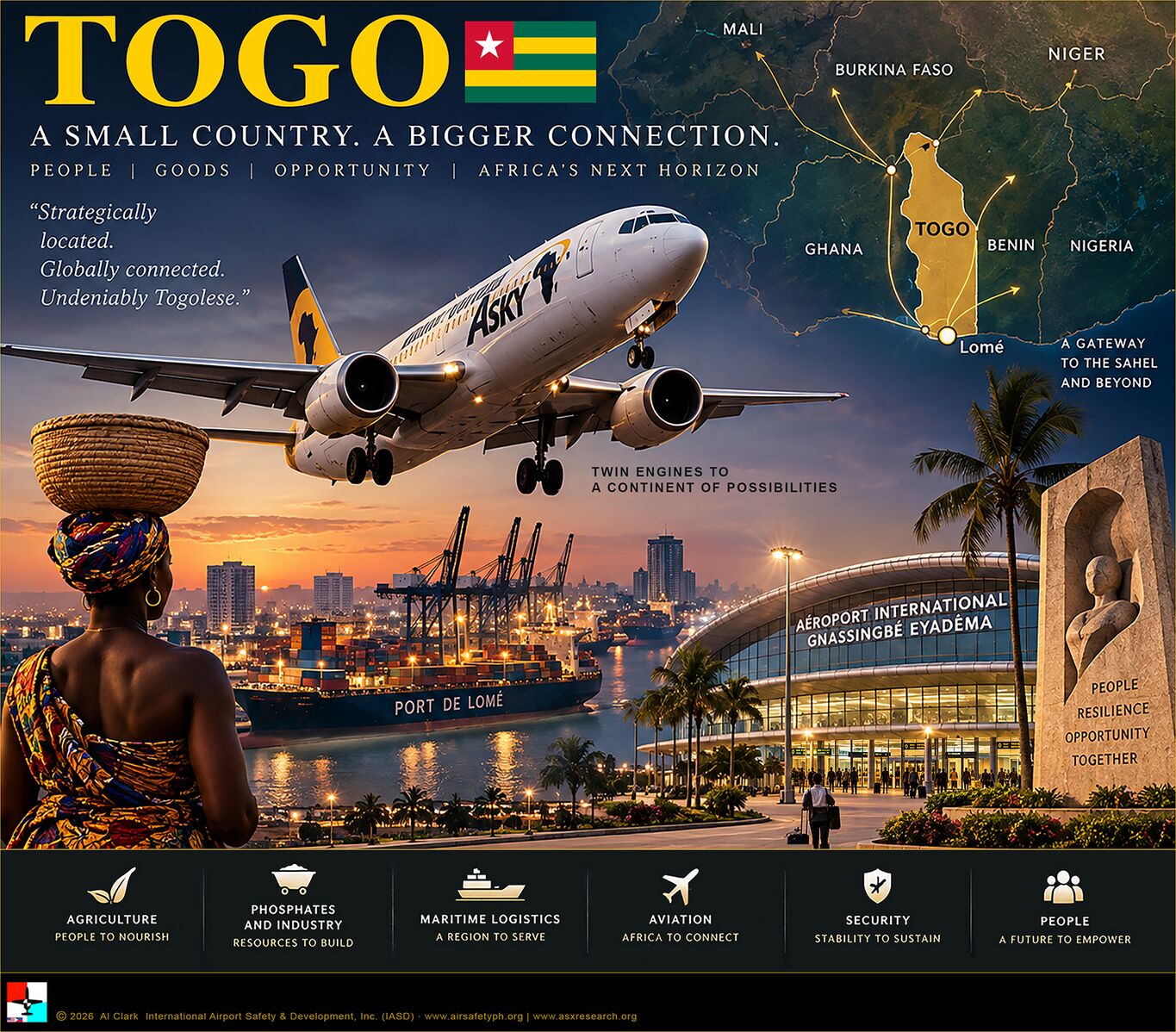
Lomé is where Togo’s disproportionate international importance becomes most visible. The city sits almost directly on the Ghanaian border and faces the Gulf of Guinea, giving it a position from which goods can move east-west along the coast and northward into the interior. Its deep-water port is therefore not merely a Togolese facility; it is a regional logistics instrument. Cargo entering Lomé can serve Togo itself but can also move toward Burkina Faso, Niger, Mali, and other inland markets, making port efficiency a matter of international economic competition. The World Bank in 2026 explicitly described Togo’s objective as reinforcing its position as a principal transport and logistics hub for the subregion and approved investments aimed at relieving congestion around the Port of Lomé, strengthening feeder roads, and developing a rail connection between the port and the Adétikopé Industrial Platform. Lomé’s commercial culture, however, long predates containerization. Nina Sylvanus (2013) documented the extraordinary role of the Nana-Benz textile traders, women whose control of wax-print distribution once made them some of West Africa’s most powerful commercial actors. Their rise and later displacement by changing global supply chains, including Chinese manufacturing, provides an unusually vivid microcosm of Togo itself: a small market repeatedly exploiting regional position, regulatory flexibility, and commercial intelligence to insert itself into much larger international systems.
Aviation reinforces that function. Lomé–Tokoin International Airport, officially Gnassingbé Eyadéma International Airport, has evolved from a national gateway into an increasingly significant connecting point for intra-African traffic. ASKY Airlines has built its operating model around Lomé, and by 2026 the airline reported a network of 30 destinations in 28 African countries, approximately 336 weekly flights, and roughly 24,000 passengers per week. Its strategic partnership with Ethiopian Airlines extends the network beyond those cities into Ethiopian’s much larger global system. Togolese statistics reported approximately 1.58 million airport passengers in 2025, including more than 465,000 transit passengers, along with 17,354 tonnes of freight. Those transit numbers reveal the key point: many people using Lomé airport are not traveling to Togo at all. They are using Togo because of where it is. In aviation terms, that makes Lomé functionally larger than the domestic economy it serves. Togo has effectively monetized geography twice—through the port at sea level and through a connecting airline network above it. The combination is unusual for a country of its size and creates the beginnings of a multimodal regional gateway in which maritime freight, road corridors, industrial processing, air cargo, passenger connectivity, and financial services can reinforce one another.
Togo’s international function is also diplomatic. The country belongs to the United Nations, African Union, Economic Community of West African States, West African Economic and Monetary Union, Organisation internationale de la Francophonie, and numerous other international institutions, while Lomé has repeatedly hosted negotiations and regional diplomacy. Its government has cultivated a reputation for maintaining working relationships across ideological divides, including Western governments, Sahelian military governments, and increasingly non-Western powers. By 2026 Faure Gnassingbé was also serving as an African Union mediator concerning the conflict in eastern Democratic Republic of the Congo. This outward-facing diplomacy is consistent with Togo’s economic logic: a small country surrounded by larger political and economic forces gains leverage not by dominating its neighborhood but by becoming useful to it. The strategy is visible in shipping, aviation, mediation, banking, trade, and transit. Even Togo’s historical market culture demonstrates this instinct. Sylvanus (2013) showed how Togolese traders inserted themselves between European manufacturing and African consumers; modern Togo increasingly attempts the same maneuver at national scale—positioning itself between producers and markets, coastal and inland economies, competing diplomatic blocs, and different regions of Africa.
The greatest threat to this model now comes from the north. Togo has not descended into civil war, but the security geography of West Africa has moved toward it. Islamist insurgencies that metastasized across Mali, Burkina Faso, and Niger have increasingly pressed into the northern territories of coastal West African states. Togo’s Savanes Region has experienced cross-border attacks since 2021, prompting a continuing state of emergency and major security deployments. The 2026 Bertelsmann Transformation Index describes escalating violence involving jihadist organizations and records significant civilian and military casualties in northern Togo. This changes Togo’s strategic equation profoundly. What made the country economically useful—the long north-south corridor linking the sea to the Sahel—also creates a potential conduit through which instability can approach the coast. Jane Maureen Ngonjock, Essossinam Ali, and Boris D. Soh Wenda (2026) show that northern Togolese agriculture already faces pressures involving climate, technology adoption, land tenure, and productivity; violent insecurity layered onto those vulnerabilities can weaken communities precisely where state legitimacy is most important. The policy challenge therefore cannot be solved by military force alone. If northern communities experience insecurity, climatic stress, limited employment, poor services, and political exclusion simultaneously, security becomes inseparable from development.
Togo’s future consequently depends upon whether its government can convert strategic infrastructure into resilient institutions. The economic outlook is promising: the African Development Bank projects continued growth, driven by services, agriculture, mining, electricity, and logistics, while fiscal consolidation and international investment could improve the country’s financial position. Digital government and financial inclusion offer additional opportunities. During the pandemic Togo became internationally noted for using digital infrastructure to identify and deliver support to vulnerable citizens, and Emily Aiken, Viraj Thakur, and Joshua Blumenstock (2022) demonstrated both the potential and complications of distributing assistance through mobile technologies in a society where telephone sharing is common. Industrial development around Adétikopé could allow Togo to capture more value from goods moving through its corridors rather than merely collecting transit revenue. Agricultural modernization could similarly turn food security into agribusiness. Yet these possibilities remain vulnerable to electricity costs, climate change, debt, educational inequality, corruption, political exclusion, and regional insecurity. Growth that occurs almost entirely in Lomé while the north remains poor and insecure would create impressive national statistics but a fragile state. Growth accompanied by stronger local economies, accountable institutions, education, and genuine participation could produce something much more durable.
Therein lies the deeper significance of Togo. Its international importance does not derive from territory, population, military strength, or abundant petroleum. It derives from position and function. Togo is a hinge: between the Atlantic and the Sahel, Anglophone Ghana and Francophone Benin, maritime commerce and inland trade, West and Central African aviation networks, old European relationships and new Chinese, Russian, Turkish, Gulf, and African partnerships. Its political history warns what can happen when stability becomes synonymous with the permanence of a ruling structure; Heilbrunn (1993), Nwajiaku (1994), Houngnikpo (2000), Ellis (1993), Skinner (2019), and Seely (2005) collectively show that Togo’s apparent continuity has repeatedly concealed profound contests over sovereignty and legitimacy. Its economic history offers the inverse lesson: adaptability can produce remarkable influence even when conventional national advantages are limited. The decisive question for the next generation is whether Togo can apply the ingenuity that built its port, commercial networks, aviation hub, and regional diplomacy to the institutions of the state itself. If it can, the country may become one of West Africa’s most consequential small states: not a power because it overwhelms others, but because regional systems increasingly work better when Togo works. And somewhere behind this entire investigation remains one anonymous reader who clicked into an aviation research repository from Togo and unknowingly caused somebody eight time zones away to ask why that little strip of West Africa mattered. As it turns out, quite a fucking lot.
References
Aiken, E. L., Thakur, V., & Blumenstock, J. E. (2022). Phone sharing and cash transfers in Togo: Quantitative evidence from mobile phone data. Proceedings of the ACM SIGCAS/SIGCHI Conference on Computing and Sustainable Societies. https://doi.org/10.1145/3530190.3534796
Ali, E., & Bayale, N. (2024). Impact of public agricultural investment on crops production, households’ welfare, and employment generation opportunities in Togo, West Africa. The European Journal of Development Research, 36(1), 161–193. https://doi.org/10.1057/s41287-023-00597-7
Bayale, N., Lanie, T., Ngaba, E. A., Nagou, M., & Abah, K. (2024). From food inflation to cash transfers and food subsidies: Assessing impacts on households’ consumption and welfare in Togo. African Development Review, 36(4), 621–632. https://doi.org/10.1111/1467-8268.12778
Dandonougbo, Y., Tossou, Y., Atake, E.-H., & Ekouevi, D. K. (2021). Effets de la COVID-19 sur la variation du revenu et la sécurité alimentaire des ménages au Togo. African Development Review, 33(S1), S194–S206. https://doi.org/10.1111/1467-8268.12529
Ellis, S. (1993). Rumour and power in Togo. Africa, 63(4), 462–476. https://doi.org/10.2307/1161002
Gmakouba, T., Dzidzienyo, D. K., Koussao, S., Tongoona, P., & Asante, I. K. (2024). Identifying cassava production constraints, farmers preferences, and cassava mosaic disease perceptions in Togo: Insights for a participatory breeding approach. Agriculture & Food Security, 13, Article 63. https://doi.org/10.1186/s40066-024-00518-9
Heilbrunn, J. R. (1993). Social origins of national conferences in Benin and Togo. The Journal of Modern African Studies, 31(2), 277–299.
Houngnikpo, M. C. (2000). The military and democratization in Africa: A comparative study of Benin and Togo. Journal of Political & Military Sociology, 28(2), 210–229.
Koudjom, E., Ngoko, E. H., Limazie, M. S., & Mafang, L. (2024). Choice of the type of school and outcomes for youth in the labour market in Togo. Journal of African Economies, 33(Supplement_1), i94–i113. https://doi.org/10.1093/jae/ejae018
Nederlof, E. S., & Dangbégnon, C. (2007). Lessons for farmer-oriented research: Experiences from a West African soil fertility management project. Agriculture and Human Values, 24, 369–387. https://doi.org/10.1007/s10460-007-9066-0
Ngonjock, J. M., Ali, E., & Soh Wenda, B. D. (2026). Climate-smart agriculture adoption and technical efficiency of smallholder farms in Northern Togo. Mitigation and Adaptation Strategies for Global Change, 31, Article 4. https://doi.org/10.1007/s11027-025-10259-0
Nwajiaku, K. (1994). The national conferences in Benin and Togo revisited. The Journal of Modern African Studies, 32(3), 429–447. https://doi.org/10.1017/S0022278X00015172
Seely, J. C. (2005). The legacies of transition governments: Post-transition dynamics in Benin and Togo. Democratization, 12(3), 357–377. https://doi.org/10.1080/13510340500126772
Skinner, K. (2019). West Africa’s first coup: Neo-colonial and Pan-African projects in Togo’s “shadow archives.” African Studies Review, 63(2), 375–398. https://doi.org/10.1017/asr.2019.39
Sylvanus, N. (2013). Chinese devils, the global market, and the declining power of Togo’s Nana-Benzes. African Studies Review, 56(1), 65–80. https://doi.org/10.1017/asr.2013.6
Buong Teksto / Transkripsiyon ng Artikulo 🇹🇬
Togo sa Bukana ng Kanlurang Africa: Kasaysayan, Kapangyarihan, Konektibidad, at ang Kinabukasan ng Isang Maliit ngunit Estratehikong Estado
Albert N. Clark
Independent Author
Inilathala: Setyembre 7, 2026
ASX Research Journal and Database
ISSN 3068-3351 (Online)
Lugar ng Paglalathala: Cadiz City, Philippines
Publisher: ASXResearch.org
Tala ng May-akda
Albert N. Clark
Department of Aerospace Sciences, ASXResearch.org
ORCID iD: https://orcid.org/0009-0002-7348-4395
Walang iniulat na salungatan ng interes ang may-akda.
Ang mga liham hinggil sa artikulong ito ay dapat ipadala kay Albert N. Clark, Email: [email protected]
Abstrak
Sinusuri ng artikulong ito ang Togo bilang isang maliit ngunit estratehikong mahalagang estado na ang heograpikong posisyon, makasaysayang pag-unlad, political continuity, at lumalawak na transportation networks ay nagbigay rito ng impluwensiyang hindi proporsiyonal sa pisikal na laki nito. Mula sa mga lipunan bago ang kolonyalismo at sa paghahati ng German Togoland, tinatalakay ng pagsusuri ang independence, ang pagpaslang kay Sylvanus Olympio noong 1963, ang mahabang pamumuno ni Gnassingbé Eyadéma, ang hindi ganap na democratization, at ang patuloy na political dominance ng pamilyang Gnassingbé. Sinusuri nito ang contemporary Togo sa magkakaugnay na dimensiyon ng governance, agriculture, poverty, industrialization, regional trade, security, diplomacy, maritime logistics, at aviation. Partikular na binibigyang-pansin ang umuusbong na papel ng Lomé bilang multimodal West African gateway, kung saan pinag-uugnay ng Port of Lomé, Gnassingbé Eyadéma International Airport, ASKY Airlines, regional highway corridors, at industrial development ang coastal economies sa mga landlocked states ng Sahel. Sinusuri rin ng artikulo ang patuloy na institutional weaknesses, socioeconomic inequality, northern insecurity, at ang paglawak patimog ng Sahelian jihadist violence bilang mga posibleng banta sa development model na ito. Ipinapangatuwiran nito na ang magiging kahalagahan ng Togo sa hinaharap ay hindi lamang nakasalalay sa economic growth o infrastructure expansion, kundi sa kakayahan nitong gawing resilient institutions, human development, political legitimacy, at broadly distributed prosperity ang geographic advantage nito. Sa huli, ipinapakita ng Togo kung paano maaaring magkaroon ng malaking international relevance ang isang geographically small country sa pamamagitan ng pagiging mahalaga sa paggalaw ng people, goods, capital, at diplomacy sa isang mas malawak na rehiyon.
Mga Susing Salita: Togo, West African Aviation, Regional Connectivity, Strategic Development
Paunang Salita
Nagsimula ang pananaliksik na ito sa iisang tao. Noong Setyembre 2026, habang sinusuri ang geographic reach ng ASX Research Journal and Database, may isang active reader na lumitaw sa analytics mula sa Togo. Sa estadistika, dapat ay walang gaanong kahulugan ang isang visitor. Sa intelektuwal na pananaw, hindi ito kayang balewalain. Bakit may isang tao sa makitid na bansang ito sa West Africa na nakahanap ng isang independent research repository na pinatatakbo mula sa Pilipinas, at ano nga ba ang nangyayari sa Togo na maaaring magbigay-katwiran upang balikan ito? Ang sagot ay naging mas malaki kaysa sa tuldok sa mapa. Maliit ang Togo sa pisikal na sukat, ngunit sinasakop nito ang isang pambihirang mahalagang strip of territory na nag-uugnay sa Gulf of Guinea at Sahelian interior. Ang kabisera nitong Lomé ay sabay na national capital, deep-water maritime gateway, international aviation hub, commercial entrepôt, diplomatic venue, at lalong mahalagang logistical bridge para sa mga landlocked states sa hilaga nito. Ang kasaysayan nito ay naglalaman ng colonial partition, frustrated nationalist projects, assassination, coups, authoritarian durability, aborted democratization, market entrepreneurship, at remarkable economic adaptation. Ang hinaharap nito ay naglalaman din ng kapansin-pansing contradictions: economic growth kasabay ng persistent poverty, increasingly sophisticated infrastructure kasabay ng political concentration, ambitious digitalization sa tabi ng malawak na informal economy, at lumalaking international relevance sa tabi ng lumalawak na jihadist threat sa northern frontier nito. Kaya ang nagsimula sa isang Togolese reader ay naging mas kawili-wiling tanong: paano nagkaroon ang napakaliit na bansang ito ng napakalaking strategic function, at ano kaya ang maaari nitong maging susunod?
Togo sa Bukana ng Kanlurang Africa: Kasaysayan, Kapangyarihan, Konektibidad, at ang Kinabukasan ng Isang Maliit ngunit Estratehikong Estado
Hindi mauunawaan ang modernong Togo na para bang bigla lamang lumitaw ang isang estado sa loob ng kasalukuyang mga hangganan nito noong 1960. Matagal bago dumating ang European colonialism, ang teritoryo ay tahanan ng iba’t ibang lipunan na ang political, linguistic, commercial, at cultural relationships ay tumatawid sa mga hangganang kalaunan lamang nabuo bilang national boundaries. Nangibabaw ang Ewe-speaking communities sa ilang bahagi ng timog at umabot pakanluran sa ngayon ay Ghana, habang ang Mina, Guin, Kabiyè, Tem, Moba, Gurma, at iba pang communities ay nanirahan sa iba’t ibang ecological at commercial zones sa hilaga at timog. Sa loob ng maraming siglo, nakipag-ugnayan ang coastal communities sa regional at Atlantic trading systems, kabilang ang marahas at mapagbagong slave trade sa Gulf of Guinea. Kalaunan, ginawang bounded colonies ng nineteenth-century European partition of West Africa ang dating magkakaugnay na cultural landscapes. Itinatag ng Germany ang protectorate of Togoland noong 1884 at nagpaunlad ng roads, plantations, export agriculture, at administrative infrastructure habang namamahala sa pamamagitan ng coercive colonial institutions. Winakasan ng pagkatalo ng Germany sa First World War ang territorial unit na iyon. Hinati ng Britain at France ang Togoland, at pormal na pinagtibay ng League of Nations at kalaunan ng United Nations trusteeship system ang partition. Ang British-administered Togoland ay kalaunang sumama sa Gold Coast at naging bahagi ng independent Ghana, habang ang French Togoland ang naging teritoryong lilitaw bilang Republic of Togo. Napakahalaga ng partition na ito dahil iniwan nitong nahahati ng international frontier ang mga communities, lalo na ang Ewe, at ginawang sentral sa late-colonial politics ang magkakatunggaling pananaw tungkol sa Togoland unification, territorial sovereignty, at postcolonial statehood. Ipinapakita ng pag-aaral ni Kate Skinner (2019) tungkol sa postcolonial “shadow archives” ng Togo kung paano nanatiling magkakaugnay ang mga argumento tungkol sa sovereignty, pan-Africanism, France, Ghana, at national legitimacy kahit matagal nang natapos ang formal colonial rule.
Nakamit ng Togo ang independence mula sa France noong Abril 27, 1960, sa ilalim ni Sylvanus Olympio, ngunit pumasok ang bagong republic sa independence na dala pa rin ang mga hindi nalutas na structures of colonial rule sa halip na tuluyang makalaya mula sa mga ito. Hinangad ni Olympio ang mas malaking economic at political autonomy mula sa France at sinikap bumuo ng distinct Togolese national project sa isang rehiyon kung saan nanatiling makapangyarihan ang architecture of French influence. Trahedyang naging maikli ang resulta. Noong Enero 13, 1963, napatay si Olympio sa isang military coup, isang pangyayaring karaniwang itinuturing na unang matagumpay na military overthrow ng isang government sa post-independence sub-Saharan Africa. Ang circumstances at motivations sa likod ng assassination ay nagbunga ng magkakaibang interpretations na kinasasangkutan ng demobilized Togolese veterans ng French colonial army, domestic political rivalry, French interests, at mas malawak na Cold War at pan-African tensions. Nagbabala si Skinner (2019) laban sa pagbawas sa coup sa iisang conspiratorial explanation, at ipinakita sa halip na maging political instruments mismo ang mga alaala ng assassination. Makalipas ang apat na taon, noong Enero 1967, inagaw ni Lieutenant Colonel Gnassingbé Eyadéma ang kapangyarihan at nagtayo ng isa sa pinakamatibay na authoritarian regimes sa Africa. Mula noon, ang Togo ay naging hindi gaanong conventional military dictatorship kundi isang highly personalized political system kung saan magkakasamang nagpapatibay sa isa’t isa ang military loyalty, patronage, ethnic at regional networks, ritualized nationalism, at ruling party. Ipinakita ni Stephen Ellis (1993) na ang kapangyarihan sa ilalim ni Eyadéma ay pinanatili hindi lamang sa formal coercion kundi sa rumor, symbolism, political mythology, information control, at tinatawag ng mga Togolese na radio trottoir—ang “sidewalk radio” kung saan umiikot ang unofficial information sa lipunan. Dahil dito, naging tunggalian ang politics ng Togo hindi lamang tungkol sa institutions kundi pati sa narratives kung paano inuunawa ang authority mismo.
Ang pamumuno ni Eyadéma mula 1967 hanggang sa kanyang pagkamatay noong 2005 ay nagbigay sa Togo ng kakaibang kombinasyon ng political continuity at institutional weakness. Itinaguyod ng regime ang imahe ng stability, at kumpara sa mga bansang gaya ng Liberia, Sierra Leone, Côte d’Ivoire, o kalaunan sa ilang bahagi ng Sahel, naiwasan nga ng Togo ang conventional civil war. Mahalaga ang distinction na iyon. Hindi magiging historically accurate na sabihing nakaranas ang Togo ng civil war. Ngunit hindi dapat ipagkamali ang kawalan ng civil war sa kawalan ng seryosong political violence. Paulit-ulit na minarkahan ang kasaysayan ng bansa ng detention, torture allegations, repression, attempted coups, violent demonstrations, security-force intervention, contested elections, at mga episode ng lethal unrest. Naging partikular na mahalaga ang military dahil ang coercive apparatus ng state ay hindi institutionally neutral; nakaugnay ito sa regime survival. Tinukoy ni Mathurin Houngnikpo (2000), sa paghahambing ng democratization sa Benin at Togo, ang stance ng military bilang isa sa decisive differences: sa Benin ay kalaunang pinahintulutan ng armed forces ang political transition, samantalang napanatili ni Eyadéma ang sapat na military allegiance upang hadlangan ito. Naging political arrangements din ang economic arrangements. Nagbigay ng critical revenue ang phosphate exports, habang umunlad ang Lomé bilang commercial center kung saan nakaaakit ng regional commerce ang lower taxes at relatively liberal trade policies. Kaya nakabuo ang regime ng isang uri ng bargain: nanatiling constrained ang political pluralism, ngunit binigyan ng puwang ang economic networks kapag nakatutulong ito sa system. Nagbunga ito ng stability of government nang walang full institutional accountability—isang pattern na napakahirap buwagin.
Sa unang bahagi ng 1990s, tila may posibilidad na mabuwag ang sistemang iyon. Ang economic crisis, domestic opposition, pagtatapos ng Cold War, foreign pressure, strikes, at demonstrations ay nag-ambag sa convening ng Sovereign National Conference ng Togo noong 1991. Sa ibang bahagi ng Francophone Africa, naging mechanisms ang katulad na conferences kung saan nire-renegotiate o binubuwag ang authoritarian systems. Ngunit naging textbook example ang Togo kung bakit maaaring magbunga ng ganap na magkaibang political outcomes ang magkaparehong constitutional mechanisms. Ipinangatwiran ni John R. Heilbrunn (1993) na ang social at institutional conditions sa paligid ng national conferences ay hindi bababa sa kasinghalaga ng conferences mismo, habang ipinakita ni Kathryn Nwajiaku (1994) na napanatili ni Eyadéma ang resources na nawala sa kanyang Beninese counterpart, lalo na ang coercive backing at sapat na political leverage upang labanan ang claim ng conference sa sovereignty. Kaya natigil ang Togolese transition. Kalaunan, ipinakita ni Jennifer C. Seely (2005) kung paano patuloy na hinubog ng institutional legacies na nalikha sa transitional governments ang post-transition politics, na bahagyang nagpapaliwanag kung bakit umusad ang Benin tungo sa alternation habang hindi ang Togo. Nanatili ang opposition politics, naging regular ang elections, at lumawak ang ilang civic space, ngunit nagpatuloy ang underlying asymmetry of power. Napatunayang pambihirang adaptive ang political system: nang gawing hindi na sustainable ng pressure ang outright one-party rule, tinanggap ng regime ang multiparty forms nang hindi isinusuko ang structural advantages na ginagawang malabong matalo ito sa election. Kaya ang dysfunctionality ng Togo ay madalas na hindi kasing dramatic ng state collapse ngunit mas durable—isang state na kayang mag-administer ng territory, magtayo ng infrastructure, umakit ng capital, at magsagawa ng diplomacy habang nananatiling resistant sa meaningful political turnover.
Malupit na inilantad ng pagkamatay ni Eyadéma noong Pebrero 2005 ang contradiction na iyon. Sa simula, iniluklok ng military ang kanyang anak na si Faure Gnassingbé sa mga circumstances na malawakang kinondena bilang unconstitutional, na nagbunsod ng matinding domestic at international pressure. Pansamantalang umatras si Faure at kalaunan ay nanalo sa presidential election na ang disputed conduct ay sinabayan ng matinding political violence at population displacement. Gayunman, nakaligtas ang dynasty. Noong 2024 at 2025, sumailalim ang Togo sa isa pang malalim na constitutional transformation, mula sa presidential model tungo sa Fifth Republic na pormal na nakabalangkas bilang parliamentary system. Tumigil si Faure Gnassingbé bilang president of the republic at noong Mayo 3, 2025, naging president of the Council of Ministers, ang institution na ngayon ay gumagamit ng central executive functions ng government, habang si Jean-Lucien Savi de Tové ang naging president of the republic sa isang largely ceremonial role. Ayon mismo sa government, ang president of the Council ang nagtatakda ng national policy, namumuno sa foreign policy, heads the armed forces, commands the security services, at gumagamit ng regulatory at appointment authority. Ipinapangatuwiran ng critics na pinanatili ng restructuring ang substance ng kapangyarihan ni Gnassingbé habang binago lamang ang constitutional location nito; inilalarawan naman ito ng supporters bilang parliamentary modernization. Ang crucial analytical fact ay nanatili ang parehong pamilya sa sentro ng Togolese executive power mula pa noong 1967. Kaya ipinapakita ng bansa ang isang remarkable political phenomenon: paulit-ulit na nagbago ang constitutional architecture, ngunit halos hindi gumalaw ang executive continuity. Umaayon ang persistence na iyon sa mas malawak na insight ni Seely (2005) na hindi awtomatikong binubura ng formal institutional change ang embedded distributions of political power.
Mas dynamic ang kuwento ng economy ng Togo. Makitid ang bansa—humigit-kumulang 600 kilometers mula Gulf of Guinea hanggang Burkina Faso—at ang mismong hugis nito ay economic asset dahil nagsisilbi ang territory bilang north-south corridor. Nanatiling mahalaga ang agriculture sa employment, livelihoods, at food security, kung saan ang maize, cassava, yams, cotton, soybeans, cashews, coffee, cocoa, at iba pang crops ay sumasakop sa iba’t ibang ecological zones. Nanatiling strategically important ang phosphate mining, habang pinalawak ng clinker, cement, manufacturing, re-export trade, transport, finance, telecommunications, at services ang economic base. Ipinapakita ng research nina Essossinam Ali at Nimonka Bayale (2024) na maaaring magkaroon ang public agricultural investment ng effects na lampas sa farm output, na nakaaapekto sa employment at household welfare sa buong Togolese economy. Ngunit ipinakikita rin ng agriculture ang persistent structural constraints. Idinokumento nina Tighankoumi Gmakouba, Daniel Kwadjo Dzidzienyo, Some Koussao, Pangirayi Tongoona, at Isaac K. Asante (2024) ang production constraints at disease challenges na nakaaapekto sa cassava, isang major food-security crop, habang natuklasan nina E. Suzanne Nederlof at Constant Dangbégnon (2007) na kahit technically sound agricultural innovations ay nabibigo kapag hindi sapat na isinasaalang-alang ng development programs ang actual constraints, incentives, at knowledge ng farmers. Kaya ang developmental problem ng Togo ay hindi kawalan ng economic activity; ito ay ang uneven transformation ng activity tungo sa productivity, formal employment, household resilience, at broadly distributed wealth.
Kasinghalaga ang human side ng economy na iyon. Nanatiling bansa ang Togo kung saan maaaring magsabay ang economic growth at malaking vulnerability, lalo na sa rural areas, informal employment, at poorer households. Tinaya ng African Development Bank ang economic growth sa 6.3 percent noong 2025, habang iniulat din ang extreme poverty na humigit-kumulang 39.3 percent at isang informal sector na sumasaklaw sa napakalaking bahagi ng economic activity. Ipinakita ng COVID-19 shock kung gaano kabilis ma-destabilize ang households na namumuhay malapit sa subsistence: natuklasan nina Yevessé Dandonougbo, Yaovi Tossou, Esso-Hanam Atake, at Didier Koumavi Ekouevi (2021), sa pag-aaral ng 1,405 households sa buong Togo, na malakas ang association ng employment loss sa declining income at reduced food consumption. Ipinapakita rin ng mas bagong modeling nina Nimonka Bayale, Tomgouani Lanie, Eric Allara Ngaba, Madow Nagou, at Kokou Abah (2024) ang vulnerability ng household welfare sa food-price inflation at nagmumungkahi na maaaring mas efficient protektahan ng well-targeted cash transfers ang consumption kaysa generalized subsidies. Nagdadagdag ang education ng isa pang dividing line. Sa pagsusuri ng higit 16,000 young Togolese, natuklasan nina Etayibtalnam Koudjom, Eric Hubert Ngoko, Mazignada Sika Limazie, at Lionie Mafang (2024) ang meaningful relationships sa school type, geography, family characteristics, at later labor-market earnings. Mahalaga ang findings na ito dahil hindi GDP growth lamang ang magtatakda ng future competitiveness ng Togo. Nakasalalay ito sa kung makalilikha ang infrastructure at trade ng population na kayang productive na lumahok sa economy sa halip na panoorin lamang ang national growth na dumaan sa paligid nila.
Sa Lomé pinakakitang-kita ang disproportionate international importance ng Togo. Halos katabi ng Ghanaian border ang lungsod at nakaharap sa Gulf of Guinea, kaya nasa posisyon itong magpalipat ng goods east-west sa kahabaan ng coast at northward papasok sa interior. Kaya ang deep-water port nito ay hindi lamang Togolese facility; isa itong regional logistics instrument. Ang cargo na pumapasok sa Lomé ay maaaring magsilbi sa Togo mismo ngunit maaari ring magtungo sa Burkina Faso, Niger, Mali, at iba pang inland markets, kaya nagiging usapin ng international economic competition ang port efficiency. Noong 2026, tahasang inilarawan ng World Bank ang objective ng Togo bilang pagpapalakas sa posisyon nito bilang principal transport and logistics hub para sa subregion at inaprubahan ang investments upang mabawasan ang congestion sa paligid ng Port of Lomé, mapalakas ang feeder roads, at makabuo ng rail connection sa pagitan ng port at Adétikopé Industrial Platform. Gayunman, mas matanda kaysa containerization ang commercial culture ng Lomé. Idinokumento ni Nina Sylvanus (2013) ang extraordinary role ng Nana-Benz textile traders, mga kababaihang ang control sa wax-print distribution ay minsang nagbigay sa kanila ng katayuan bilang ilan sa pinakamakapangyarihang commercial actors sa West Africa. Ang kanilang pag-angat at kalaunang displacement dahil sa pagbabago ng global supply chains, kabilang ang Chinese manufacturing, ay nagbibigay ng napakalinaw na microcosm ng Togo mismo: isang maliit na market na paulit-ulit na ginagamit ang regional position, regulatory flexibility, at commercial intelligence upang ipasok ang sarili sa mas malalaking international systems.
Pinatitibay ng aviation ang function na iyon. Ang Lomé–Tokoin International Airport, na opisyal na Gnassingbé Eyadéma International Airport, ay nag-evolve mula national gateway tungo sa increasingly significant connecting point para sa intra-African traffic. Itinayo ng ASKY Airlines ang operating model nito sa Lomé, at pagsapit ng 2026 iniulat ng airline ang network na 30 destinations sa 28 African countries, humigit-kumulang 336 weekly flights, at halos 24,000 passengers bawat linggo. Pinalalawak ng strategic partnership nito sa Ethiopian Airlines ang network lampas sa mga lungsod na iyon patungo sa mas malaking global system ng Ethiopian. Iniulat ng Togolese statistics ang humigit-kumulang 1.58 million airport passengers noong 2025, kabilang ang higit 465,000 transit passengers, kasama ang 17,354 tonnes of freight. Ipinakikita ng transit numbers ang mahalagang punto: marami sa gumagamit ng Lomé airport ay hindi naman naglalakbay patungong Togo. Ginagamit nila ang Togo dahil sa lokasyon nito. Sa aviation terms, ginagawa nitong functionally larger ang Lomé kaysa sa domestic economy na pinaglilingkuran nito. Epektibong dalawang beses na na-monetize ng Togo ang geography—sa port sa sea level at sa connecting airline network sa itaas nito. Hindi pangkaraniwan ang kombinasyong ito para sa bansang kasingliit nito at lumilikha ito ng simula ng multimodal regional gateway kung saan maaaring magpalakas sa isa’t isa ang maritime freight, road corridors, industrial processing, air cargo, passenger connectivity, at financial services.
Diplomatic din ang international function ng Togo. Miyembro ang bansa ng United Nations, African Union, Economic Community of West African States, West African Economic and Monetary Union, Organisation internationale de la Francophonie, at maraming iba pang international institutions, habang paulit-ulit na nag-host ang Lomé ng negotiations at regional diplomacy. Nilinang ng government nito ang reputasyon sa pagpapanatili ng working relationships sa iba’t ibang ideological divides, kabilang ang Western governments, Sahelian military governments, at increasingly non-Western powers. Pagsapit ng 2026, nagsisilbi rin si Faure Gnassingbé bilang African Union mediator tungkol sa conflict sa eastern Democratic Republic of the Congo. Umaayon ang outward-facing diplomacy na ito sa economic logic ng Togo: ang isang maliit na bansang napapalibutan ng mas malalaking political at economic forces ay nakakakuha ng leverage hindi sa pagdomina sa neighborhood nito kundi sa pagiging useful dito. Makikita ang strategy sa shipping, aviation, mediation, banking, trade, at transit. Maging ang historical market culture ng Togo ay nagpapakita ng instinct na ito. Ipinakita ni Sylvanus (2013) kung paano inilagay ng Togolese traders ang kanilang sarili sa pagitan ng European manufacturing at African consumers; lalong sinusubukan ng modernong Togo ang parehong maneuver sa national scale—pagpoposisyon sa sarili sa pagitan ng producers at markets, coastal at inland economies, competing diplomatic blocs, at iba’t ibang regions of Africa.
Ang pinakamalaking banta sa model na ito ay nagmumula ngayon sa hilaga. Hindi bumagsak ang Togo sa civil war, ngunit ang security geography ng West Africa ay gumalaw patungo rito. Ang Islamist insurgencies na kumalat sa Mali, Burkina Faso, at Niger ay lalong pumapasok sa northern territories ng coastal West African states. Nakaranas ang Savanes Region ng Togo ng cross-border attacks mula 2021, na nagbunsod ng patuloy na state of emergency at major security deployments. Inilalarawan ng 2026 Bertelsmann Transformation Index ang escalating violence na kinasasangkutan ng jihadist organizations at nagtatala ng significant civilian at military casualties sa northern Togo. Malalim nitong binabago ang strategic equation ng Togo. Ang mismong bagay na nagbigay sa bansa ng economic utility—ang mahabang north-south corridor na nag-uugnay sa sea at Sahel—ay lumilikha rin ng potential conduit kung saan maaaring lumapit ang instability sa coast. Ipinapakita nina Jane Maureen Ngonjock, Essossinam Ali, at Boris D. Soh Wenda (2026) na ang agriculture sa northern Togo ay nahaharap na sa pressures na may kaugnayan sa climate, technology adoption, land tenure, at productivity; kapag nadagdagan ng violent insecurity ang vulnerabilities na iyon, maaaring humina ang communities sa mismong lugar kung saan pinakamahalaga ang state legitimacy. Kaya hindi maaaring military force lamang ang sagot sa policy challenge. Kung sabay na nakararanas ang northern communities ng insecurity, climatic stress, limited employment, poor services, at political exclusion, nagiging inseparable ang security at development.
Dahil dito, nakasalalay ang future ng Togo sa kung kayang gawing resilient institutions ng government nito ang strategic infrastructure. Promising ang economic outlook: inaasahan ng African Development Bank ang continued growth na pinangungunahan ng services, agriculture, mining, electricity, at logistics, habang maaaring mapabuti ng fiscal consolidation at international investment ang financial position ng bansa. Nagbibigay din ng opportunities ang digital government at financial inclusion. Noong pandemic, nakilala internationally ang Togo sa paggamit ng digital infrastructure upang matukoy at maihatid ang support sa vulnerable citizens, at ipinakita nina Emily Aiken, Viraj Thakur, at Joshua Blumenstock (2022) kapwa ang potential at complications ng pag-distribute ng assistance sa pamamagitan ng mobile technologies sa lipunang karaniwan ang telephone sharing. Maaaring payagan ng industrial development sa paligid ng Adétikopé ang Togo na makakuha ng mas malaking value mula sa goods na dumadaan sa corridors nito sa halip na transit revenue lamang. Maaari ring gawing agribusiness ng agricultural modernization ang food security. Ngunit vulnerable pa rin ang mga possibility na ito sa electricity costs, climate change, debt, educational inequality, corruption, political exclusion, at regional insecurity. Ang growth na halos sa Lomé lamang nangyayari habang nananatiling poor at insecure ang north ay maaaring lumikha ng impressive national statistics ngunit fragile state. Ang growth na sinasabayan ng stronger local economies, accountable institutions, education, at genuine participation ay maaaring lumikha ng mas durable na resulta.
Dito makikita ang mas malalim na kahalagahan ng Togo. Ang international importance nito ay hindi nagmumula sa territory, population, military strength, o abundant petroleum. Nagmumula ito sa position at function. Ang Togo ay isang hinge: sa pagitan ng Atlantic at Sahel, Anglophone Ghana at Francophone Benin, maritime commerce at inland trade, West at Central African aviation networks, old European relationships at new Chinese, Russian, Turkish, Gulf, at African partnerships. Nagbabala ang political history nito kung ano ang maaaring mangyari kapag naging synonymous ang stability sa permanence ng isang ruling structure; sama-samang ipinapakita nina Heilbrunn (1993), Nwajiaku (1994), Houngnikpo (2000), Ellis (1993), Skinner (2019), at Seely (2005) na paulit-ulit na itinago ng apparent continuity ng Togo ang malalim na contests over sovereignty at legitimacy. Ang economic history nito naman ay nagbibigay ng inverse lesson: maaaring lumikha ang adaptability ng remarkable influence kahit limitado ang conventional national advantages. Ang decisive question para sa susunod na generation ay kung mailalapat ng Togo sa institutions of the state mismo ang ingenuity na nagtayo ng port, commercial networks, aviation hub, at regional diplomacy nito. Kung magagawa nito, maaaring maging isa ang bansa sa most consequential small states ng West Africa: hindi isang power dahil dinadaig nito ang iba, kundi dahil lalong gumagana nang mas mahusay ang regional systems kapag gumagana ang Togo. At sa likod ng buong investigation na ito ay nananatili ang isang anonymous reader na nag-click sa isang aviation research repository mula sa Togo at hindi sinasadyang nag-udyok sa isang tao walong time zones ang layo upang itanong kung bakit mahalaga ang maliit na strip na iyon ng West Africa. Sa lumalabas, napakalaking bagay pala nito.
Mga Sanggunian
Aiken, E. L., Thakur, V., & Blumenstock, J. E. (2022). Phone sharing and cash transfers in Togo: Quantitative evidence from mobile phone data. Proceedings of the ACM SIGCAS/SIGCHI Conference on Computing and Sustainable Societies. https://doi.org/10.1145/3530190.3534796
Ali, E., & Bayale, N. (2024). Impact of public agricultural investment on crops production, households’ welfare, and employment generation opportunities in Togo, West Africa. The European Journal of Development Research, 36(1), 161–193. https://doi.org/10.1057/s41287-023-00597-7
Bayale, N., Lanie, T., Ngaba, E. A., Nagou, M., & Abah, K. (2024). From food inflation to cash transfers and food subsidies: Assessing impacts on households’ consumption and welfare in Togo. African Development Review, 36(4), 621–632. https://doi.org/10.1111/1467-8268.12778
Dandonougbo, Y., Tossou, Y., Atake, E.-H., & Ekouevi, D. K. (2021). Effets de la COVID-19 sur la variation du revenu et la sécurité alimentaire des ménages au Togo. African Development Review, 33(S1), S194–S206. https://doi.org/10.1111/1467-8268.12529
Ellis, S. (1993). Rumour and power in Togo. Africa, 63(4), 462–476. https://doi.org/10.2307/1161002
Gmakouba, T., Dzidzienyo, D. K., Koussao, S., Tongoona, P., & Asante, I. K. (2024). Identifying cassava production constraints, farmers preferences, and cassava mosaic disease perceptions in Togo: Insights for a participatory breeding approach. Agriculture & Food Security, 13, Article 63. https://doi.org/10.1186/s40066-024-00518-9
Heilbrunn, J. R. (1993). Social origins of national conferences in Benin and Togo. The Journal of Modern African Studies, 31(2), 277–299.
Houngnikpo, M. C. (2000). The military and democratization in Africa: A comparative study of Benin and Togo. Journal of Political & Military Sociology, 28(2), 210–229.
Koudjom, E., Ngoko, E. H., Limazie, M. S., & Mafang, L. (2024). Choice of the type of school and outcomes for youth in the labour market in Togo. Journal of African Economies, 33(Supplement_1), i94–i113. https://doi.org/10.1093/jae/ejae018
Nederlof, E. S., & Dangbégnon, C. (2007). Lessons for farmer-oriented research: Experiences from a West African soil fertility management project. Agriculture and Human Values, 24, 369–387. https://doi.org/10.1007/s10460-007-9066-0
Ngonjock, J. M., Ali, E., & Soh Wenda, B. D. (2026). Climate-smart agriculture adoption and technical efficiency of smallholder farms in Northern Togo. Mitigation and Adaptation Strategies for Global Change, 31, Article 4. https://doi.org/10.1007/s11027-025-10259-0
Nwajiaku, K. (1994). The national conferences in Benin and Togo revisited. The Journal of Modern African Studies, 32(3), 429–447. https://doi.org/10.1017/S0022278X00015172
Seely, J. C. (2005). The legacies of transition governments: Post-transition dynamics in Benin and Togo. Democratization, 12(3), 357–377. https://doi.org/10.1080/13510340500126772
Skinner, K. (2019). West Africa’s first coup: Neo-colonial and Pan-African projects in Togo’s “shadow archives.” African Studies Review, 63(2), 375–398. https://doi.org/10.1017/asr.2019.39
Sylvanus, N. (2013). Chinese devils, the global market, and the declining power of Togo’s Nana-Benzes. African Studies Review, 56(1), 65–80. https://doi.org/10.1017/asr.2013.6